

Georgian Silver
Georgian Silver refers to objects made out of sterling silver (mostly household silver such as tea ware and tableware, centrepieces, cutlery, objects-de-vertu, collectables, etc.) produced in England during the consecutive reigns of King George I (1714-1727), King George II (1727-1760), King George III (1760-1820) and King George IV (1820-1830).
The style and technique in manufacturing silver during this era (over 100 years) changed radically, reflecting the variations in taste, society, costumes, economic and political situations.
The early Georgian pieces (from the early until the late 18th Century) are usually characterised by simple forms. The plain and linear design is never meant to compromise the object’s usefulness.
Obvious exceptions can be found in the highly decorative Rococo pieces, a taste introduced in England by Huguenot silversmiths (French Protestants that came to England to flee religious prosecution in France). This type of silver is usually characterised by elaborate and very ornate designs, profusely chased, embossed and often embellished with figural and sculptural elements.
The most famous Huguenot is without a doubt Paul de Lamerie (1688-1751), the greatest silversmith working in England in the 18th Century.
The silverware produced during the second half of the 18th Century is defined by a plainer and more linear design, inspired by the elegant and measured Neo-classical style. The forms became simpler and clearer, rarely chased and often engraved in a technique called “bright-cut” (realised with a series of short cuts into the metal using a polished tool to reflect the light and give the engraved decoration a particular brightness).
Popular motifs such as floral and foliate swags and festoons, rosettes and grotesques are taken from the “classical” art - Ancient Greece and Ancient Rome - inspired by archaeological discoveries such as those made at Herculaneum and Pompeii.

19th Century pair George IV silver wine coolers and liners, each exceptionally heavy and crisp, decorative and ornamental, tapering lobed body chased with shaped circular border and foot with spume rims, applied with cast flowers and leaves, cast foliage handles with flowers. Hallmarked English silver (925), London, year 1825 (k), Maker's mark BS for Benjamin Smith III.
REFERENCE NUMBER: A3171

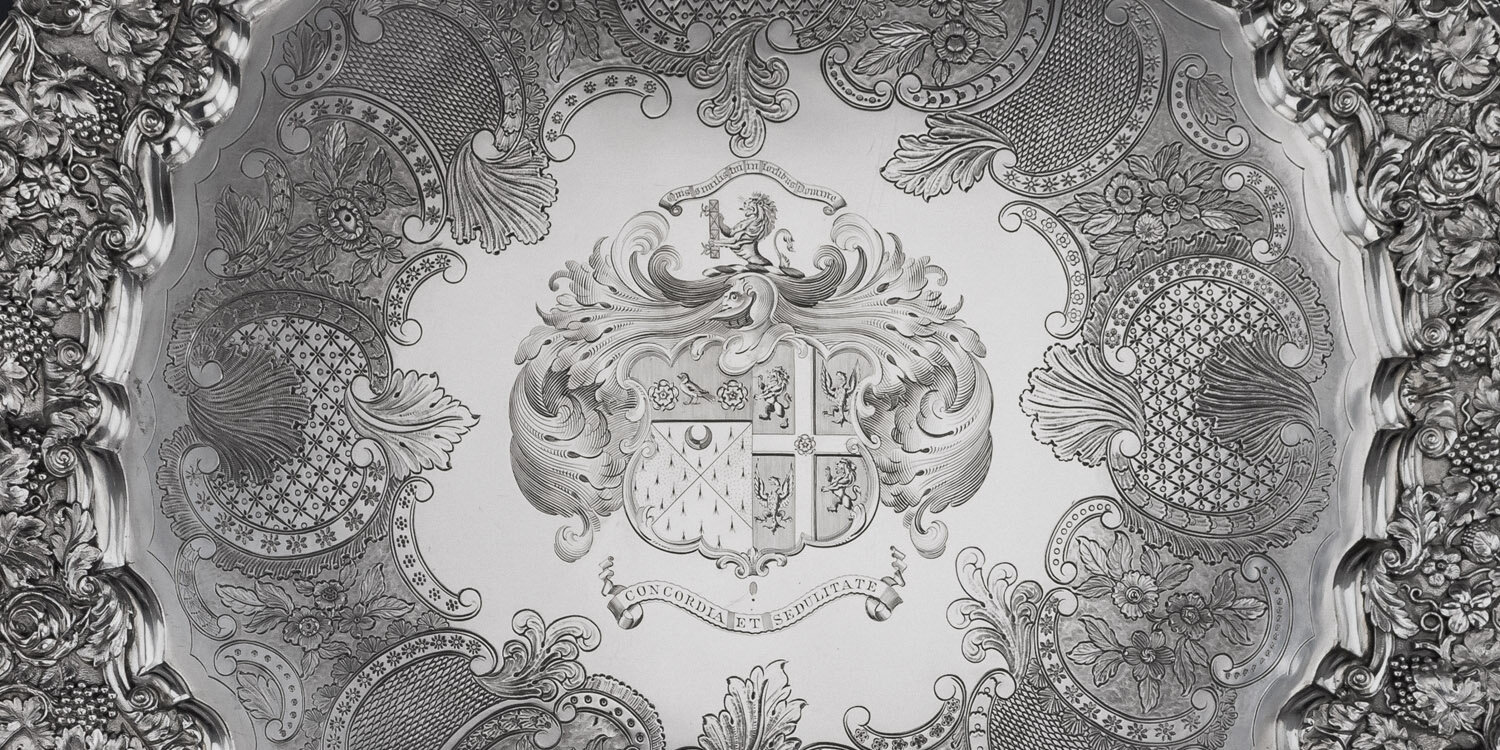
19th Century George IV silver salver with cast border, impressively large size and extremely heavy gauge, of shaped-circular form on three impressive cast feet, with applied cast border depicting grapevine and flowers, the centre chased with scrolls and flowers and featuring an exceptional coat of arms for the Goldsmid family. Hallmarked English Silver (925), London, year 1825 (k), Maker's mark IET for John Edward Terrey.
Reference Number: A4174
This item is eligible for the Pushkin’s Promise scheme.

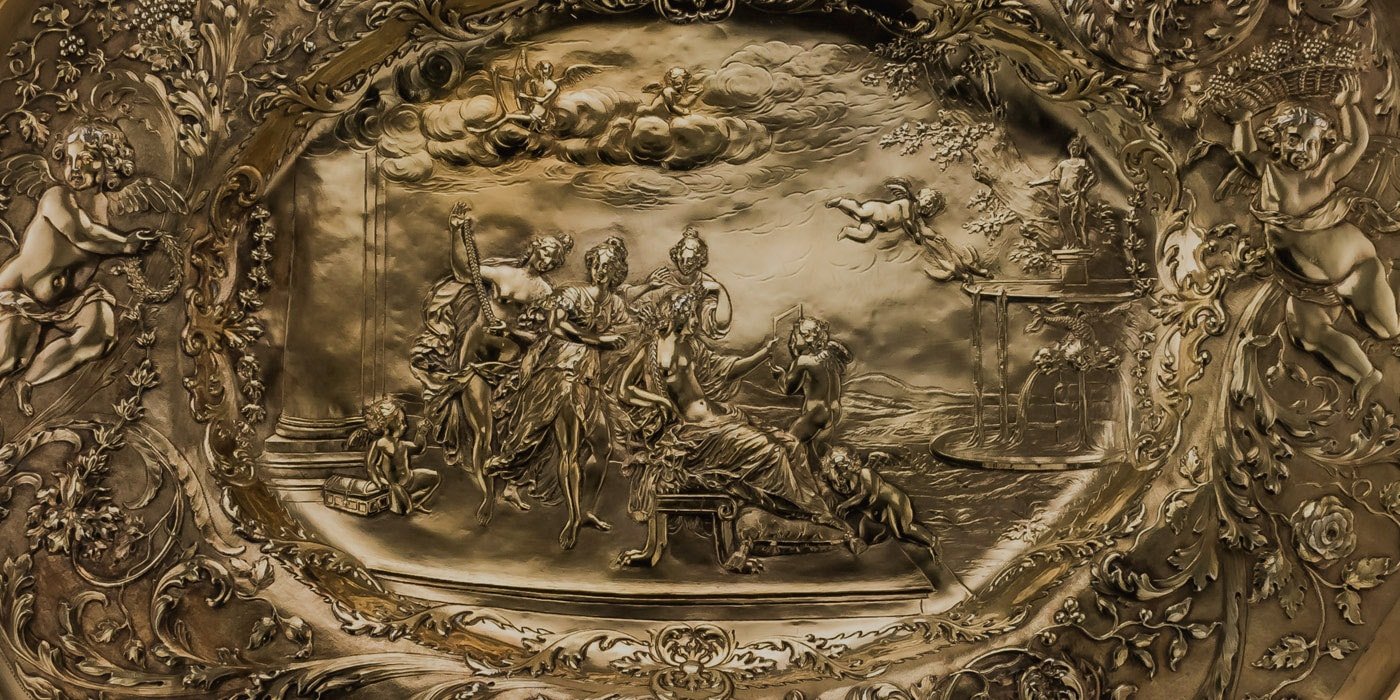
19th Century Georgian silver extremely heavy cast and embossed tea and coffee set. In the style of the 17th Century Dutch paintings depicting scenes in high relief, one side profusely embossed and applied with a Mythological wedding feast, the other side depicting a crowdy cavalry battle in high relief, each piece rests on four cast feet modelled like dog's heads, the tea and coffee pots featuring an eagle-shaped spout and with carved eagle-shaped handles and figural finials, the sugar bowl and the cream jug are applied with cast flying bird handles.
Hallmarked English Silver (Britannia 958), London, year 1816 (a), Maker's mark EF for Edward Farrell.
Reference Number: A2412
One of the key figures of this period is the Scottish architect Robert Adam (1728-1792), who played a major role in introducing Neo-classicism into Britain. His style, known as “Adam Style”, applied to all elements of interior decoration, from architecture to furniture and silver.
One of the greatest silversmiths operating in this style is Hester Bateman (1708-1794): she is the most renowned and appreciated female silversmith of all time. Following the death of her husband she successfully ran the business for thirty years and gave origin to a family business that lasted until the mid-19th Century.
At the opening of the new Century the style gradually changed, introducing a new variety of highly decorative patterns.
Edward Farrel (1779-1850), for instance, produced incredible sculptural pieces, embossed in high-relief, often gilt, decorated in a variety of original revival styles inspired by 17th Century Flemish, German or Italian paintings. The most known and popular pattern used by Farrel on tea services features tavern scenes, re-inventing Dutch genre paintings by David Teniers the Younger (1610-1690).
The Georgian period ends with the Regency era (1811-1837), an age characterised by distinctive trends in British architecture, art and culture. The major source of inspiration was found in Greek and Roman antiquity, from which designers borrowed ornamental patterns.

19th Century Georgian silver Chinese style tea kettle on a three feet spirit burner stand. The inverted pear-shaped kettle is profusely embossed with Chinese motifs, the three scroll feet formed as Chinese males and the design is repeated in the handle, the spout formed as a winged dragon. The hinged lid is embossed with flowers and surmounted by a floral finial.
Hallmarked English silver (925), London, year 1829 (o), Maker's mark P.S for Paul Storr.
REFERENCE NUMBER: A4499

18th Century Georgian Silver hot water jug / ewer, urn shaped with cast beaded borders, hinged cover surmounted by a vase-shaped finial, wooden scroll handle.
Hallmarked English Silver (925), London, year 1786 (l), Maker's mark H.B for Hester Bateman.
Reference Number: A3819

Antique 19th Century Victorian unusual solid silver four piece tea and coffee set, comprising of coffee pot, teapot, sugar bowl and milk jug, each pear-form body is chased and applied with rustic scenes of peasants merry-making, in the style of the Dutch painter David Teniers.
Reference Number: A5080
Paul Storr (1771-1844) was the most important silversmith operating during this period, and is considered the greatest English goldsmith and silversmith of all time. His range varied from tableware to magnificent sculptural pieces made for royalty.
He initially studied with the Swedish born silversmith Andrew Fogelberg, he later associated with the Royal silversmiths Rundell & Bridge and is universally known for a wide range of silverware produced for British and foreign Royalty and aristocracy. Paul Storr produced some of the most exceptional silver pieces ever made, often inspired by ancient Roman silver or in Rococo style.
Victorian Silver
The reign of Queen Victoria, also known as “Victorian Era”, is one of the longest periods of peace and prosperity in Britain’s history, spanning from 1837 to 1901. The prolonged, steady and widespread wealth, due to the political, economic, industrial and colonial consolidation of the British Empire, reflected on many of the contemporary aspects of social life such as literature, art, architecture, fashion, jewellery and silverware.
Silver was highly valued during this period and large silver table services became an essential requirement for aristocratic and emerging middle-class families.
The Victorian style applied to decorative art is generally characterised by an ornamental design, with chased and embossed relief-work with flowers, scrolling leaves and birds, often featuring cartouches engraved with initials, family crests or coat of arms. Silverware became increasingly popular, impressive and original in style. Neo-Rococo, Oriental, Neo-Renaissance and neo-Gothic are just few of the many patterns used by silversmiths between the mid-19th Century and the beginning of the 20th Century.
Under her reign, Queen Victoria commissioned numerous impressive silver table garnitures and fabulous centrepieces to important contemporary firms, some of which were consequently rewarded with a Royal Warrant.

19th Century Victorian Aesthetic Movement silver tea & coffee service, comprising of a hot water kettle, coffee pot, teapot, sugar bowl, cream jug and tray. The set is extremely unusual and rare in design and finely crafted, engraved with highly-decorative flowers and birds in the oriental inspired style.
Hallmarked English silver (925), London, year 1880 (E), 1881 (F), Maker's mark JAHES for Joseph, Albert, Horace & Ethelbert Savory, Retailed by Goldsmiths Alliance Limited.
Reference Number: A6004
This item is eligible for the Pushkin’s Promise scheme.

19th Century Victorian set of 8 silver dragon bowls, raised on a circular spreading foot, the fluted body embossed with floral decoration, sides applied with cast dragons entwining a c-shaped scroll handle. The set is of outstanding quality and features an incredibly crisp and elaborate decoration, each side of the bowl bearing the initials AL.
Hallmarked English Silver (925), London, year 1894 (T), 1895 (U), Maker's mark JBC (Carrington & Co).
Reference Number: A6961

19th Century Victorian silver magnificent and impressive five piece tea and coffee set, comprising of tea kettle on stand, coffee pot, teapot, sugar bowl and milk jug, each very heavy and impressive, each pear-form body with chased and applied rustic scenes of peasants merry-making, in the style of the Dutch painter David Teniers. Some of the handles are cast as a drunken peasant perched on a tree branch, figural finials with drunken peasants sitting on barrels.
Hallmarked English Silver (925), London, the tea kettle year 1872 (r), all the other parts year 1874 (t), Maker's mark on each part "IF" for John Figg.
Reference Number: A3323
Robert Garrard was one the most preeminent Royal silversmiths and jewellers of the period, specializing in the production of magnificent sculptural pieces. The firm, later Garrard & Co, was appointed Royal Silversmiths and Crown Jeweller in 1843.
Another important Victorian firm was Elkington & Co, founded in 1836. They patented the revolutionary techniques for electrotyping, plating and gilding and won prizes in numerous International Exhibitions.
Carrington & Co was founded in 1780 and obtained Royal Warrants from Queen Victoria, Prince Albert, Edward VII, George V and the Russian Tsars.
Hunt and Roskell (John Hunt and Robert Roskell), were silversmiths and jewellers to Queen Victoria and other European Royal families. The company was founded by Paul Storr in 1819, later Storr & Mortimer (1822-38), Mortimer & Hunt (John Samuel Hunt, 1838-43) and finally Hunt & Roskell (1843-97).
Each of these important silversmiths produced some of the most extraordinary silver examples made during the Victorian era, many of which are nowadays held in Royal collections or museums such as the Victoria & Albert in London and the Metropolitan in New York.
Victorian silver doesn’t necessarily mean large services and big pieces. The so called “Novelty silver” appealed to a wide range of collectors looking for unusual, surprising and rare designs which applied to all sort of objects: enamelled vesta cases, embossed “castle top” card cases, vinaigrettes and snuff boxes, erotic cigarette cases, figural pepperettes, cruet sets and tea caddies, scent bottles, and much more.
Samson Mordan and Nathaniel Mills are the best known and most sought after silversmiths specialising in this sort of small, highly decorative or peculiar items.
During the late 19th Century, and, subsequently, during the early 20th Century with the reign of King Edward VII (1901-1910), the taste changed. The Art Nouveau and Arts and Crafts styles became more and more popular across Europe and the United States, emphasizing organic and naturalistic stylized lines and floral patterns. During this period important English designers, such as Charles Ashbee for the Guild of Andicraft, Archibald Knox for Liberty & Co, Omar Ramsden and Alwyn Carr produced silverware in the Arts & Crafts style, challenging the Victorian industrialism and bringing the concept of design and authorship to a new level.
20th Century English Silver
Decorative silver is commonly associated with old and antique ware, as in the past most collectors have been investing in early pieces.
This interest for Renaissance and Baroque styles brought revivals into fashion. This tendency is considered typical of the 19th century, but continued in the Edwardian period and even after, when in England important firms such as Carrington & Co, Crichton Brothers, Barnard & Sons, Comyns & Sons, Vander, Mappin & Webb, Walker & Hall and others produced a large quantity of good quality 17th, 18th and 19th century replicas.
But the most peculiar feature of 20th century silver is the success of Art Deco forms, popularised by luxury retailers and manufacturers (Asprey in England, Tiffany in America and Cartier in France).
In the second half of the century key-members of the post-war school of silver such as Gerald Benney and Stuart Devlin in Britain and George Jensen in Scandinavia took inspiration from Modernism and abstract art, echoing the simpler and stylish forms of the Art Deco period and experimenting with new materials, enamel techniques and textures.

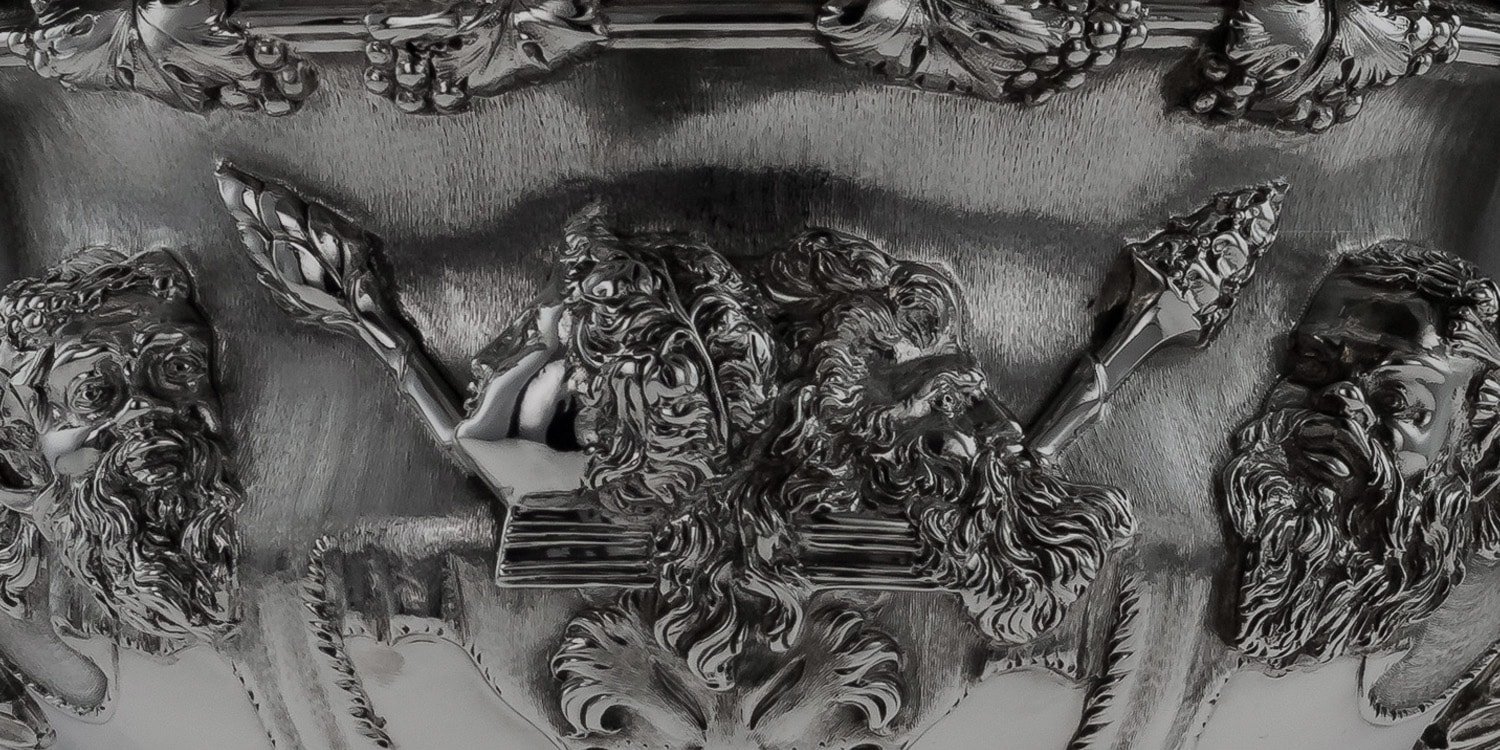
Antique 20th Century Edwardian solid silver monumental cup & cover, campana form, particularly large and heavy gauge, applied with foliage, cast scroll handles with realistically modelled maidens heads thumbpieces, both sides decorated with mythological scenes of Neptune and Amphitrite flanked by cherubs, merman and sea horses. The cover also chased and applied with scrolls and flowers and a rather large artichoke scroll finial.
Reference Number: C5098

20th Century Elizabeth II silver large punch set, consisting of a serving dish, punch bowl, cups and ladle, the bowl raised on a circular fluted foot, the bowls rim and foot chased with grapevine motifs, same pattern consistent with the dish.
Hallmarked English Silver (925 ), London, year 1972 (r), Maker's G&Co Ld for Garrard & Co Ltd.
Reference Number: A6154

20th Century British centerpieces, each modelled as a quiver of arrows supporting a laurel wreath, on a recumbent writhen dragon, mounted to an ebonised wooden base applied with crowned rifle regiment insignias and crowned initials.
Hallmarked English silver (925), London, year 1961 (f), Maker W&W for Wakely & Wheeler).
Reference Number: A6955