


Recent Acquisitions

Antique 19th Century Chinese Export solid silver wine ewer, impressive and exceptionally fine quality. Of baluster form, the body is richly worked with densely rendered village scenes, populated by numerous figures amid buildings and trees, and set to one side with a shield shaped cartouche. The neck is finely decorated with water buffalo among reeds, while the cover is surmounted with a warrior figure, presumably Guan Yu (关羽), shown in a martial setting.
The handle is naturalistically modelled as a water dragon. Of particular note is the rare mechanical feature ingeniously incorporated into the handle: a concealed lever operating the hinged cover, enabling it to open and close smoothly. The decoration throughout is exceptionally crisp and intricate, incorporating many of the most admired motifs and techniques found in Chinese Export silver, including engraved stylised foliage, bamboo leaves, animal forms, an applied dragon handle, and the highly sought-after village scenes associated with noble life. The circular stepped foot is further embellished with carp and aquatic vegetation.
The base is Hallmarked Chinese silver, Artisans mark 昌發 (Cheung Fat). Retailer's mark "HC" for Hung Chong & Co (11b Nanking Road, Shanghai).
Reference Number: C5761z

Antique 19th Century French 18k gold, nephrite, diamond and ruby miniature cup / charka made in a Russian style. The body of the cup is crafted from a perfectly polished round piece of nephrite, elegantly mounted with a solid gold rim, base rim, and handle. The C-shaped handle features a finely modelled lion motif, embellished with ruby cabochons and mine cut diamonds. A remarkable decorative piece, ideal for cabinet display or as part of a fine collection.
The cup is unhallmarked but has been tested and confirmed as high-purity gold (18ct+).
Reference Number: J12514

Antique early 19th Century French Empire solid silver confiturier, created in the distinctive ‘Retour d’Égypte’ style that emerged in France following Napoleon’s Egyptian campaign. Finely cast winged sphinx figures support the pierced gallery, one of the defining features of this highly recognisable design movement. Anthemion borders, Greek key decoration, and classical detailing throughout reflect the strong influence of antiquity on Empire period decorative arts.
The domed cover, surmounted by a pinecone finial, continues the classical theme, while the fitted set of twelve silver gilt spoons provides a rich contrast against the silver surface. The confiturier was made in Paris by the silversmith Augustin Desnoyers-Hubert in 1805, accompanied by a matching set of twelve silver gilt spoons by Jean-Joseph Rivet, dating to 1825.
Hallmarked French silver (950 Standard).
Reference Number: N12170

Antique late 19th Century Chinese Export solid silver teapot of globular form, the body is richly worked in high relief repoussé and chased decoration with continuous narrative scenes of figures, warriors, pavilions, bridges, trees and rocky landscapes. The finely textured grounds give depth and definition to the elaborate composition. The curved spout is chased with flowering foliage, while the articulated mounts support a large carved dark hardwood swing handle. The detachable circular cover is similarly decorated with floral motifs and surmounted by a sculptural silver finial. The teapot stands on a simple circular collet foot.
Hallmarked Chinese silver (tested 900+ purity), Artisan's mark "泉記 (Quan Ji)", Retailers mark LC (Lee Ching).
Reference Number: A00238

Antique early-19th Century Exceptional Swiss 18k gold & enamel music box, of elegant rectangular form, in the shape of an envelope, featuring convex front and rear sides. The cover and base are adorned with rectangular panels of translucent blue enamel over an engine-turned ground, framed by foliate taille d'épargne borders. The cover is further enhanced with an overlapping lyre-shaped, matted gold panel mimicking an envelope flap, intricately stamped with trailing foliage and embellished with split pearls and a central turquoise. The box incorporates a concealed musical movement, wound by a key and activated by a lever discreetly located at the rear.
Hallmarked by renowned goldsmith GR for Jean-Georges Rémond, Geneva, and bears additional prestige marks, reflecting its superior craftsmanship and provenance. Numbered 949, the movement playing a tune, with original key, Movement attributed to Piguet & Capt, Isaac-Daniel Piguet (1775-1841) was born in Le Chenit (Vaud) and is said to have moved to Geneva before 1800. He entered into partnership with his brother-in-law Henri Capt, another mécanicien, on 10 February 1802. The firm was active for a short period from 1802 to 1811. Piguet & Capt, however, were the first to make objects that combined automata and music for use in luxury objects, such as snuff boxes, jewelry, and watches.
Reference Number: A10228
This item is eligible for the Pushkin’s Promise scheme.

Antique late-19th Century very rare and highly decorative Italian solid silver three piece tea set by G. Accarisi. Each piece profusely chased with scrolling foliage and fantastical ornament, mounted with sculptural handles and finials in the form of grotesque, mythological, and winged creatures. Hallmarked to each piece "G ACCARISI, FIRENZE".
Reference Number: A00252

Antique late 19th Century Italian repoussé and chased solid silver covered urn, crafted in an elegant semi ovoid form and richly embellished with high relief decorative work throughout. The urn is fitted with a domed cover surmounted by a finely modeled child (putto) finial, while the body is flanked by a pair of dramatic figural scroll handles depicting winged female forms gracefully integrated into scrolling volutes.
The body is lavishly ornamented with intricate repoussé and chased decoration, featuring classical nude figures, cherubic putti, portrait medallions, grotesque masks, fruit garlands, scrolling acanthus leaves, and elaborate Rococo inspired motifs. The principal reserves depict finely sculpted mythological style figures framed by ornate foliage and scrolling ornament, with additional putti in flight adorning the upper sections. The domed cover echoes the richly textured decoration of the body, while the circular foot displays complementary repoussé foliate ornamentation. The urn is raised on a stemmed circular foot, which is weighted / reinforced for stability.
The upper rim is engraved "C. Calvi Roma 1874," identifying the Roman retailer or maker and commemorating the date. The side of the body and the flange of the cover are hallmarked with the French "weevil" hallmark (800/1000 grade) This import mark was applied to silver articles imported into France from contracting countries between 1864 and 1893.
Reference Number: A00253

Antique late-19th Century Indian (Madras) solid silver double handled very large sugar bowl, beautifully decorated with a repoussé frieze depicting a ceremonial procession in honour of the Hindu god Ganesh, set against a finely matted background. The shoulder of the cup is embellished with an elegant floral border, while the twin handles are expertly modelled as Indian cobras (Naja naja), a distinctive and highly decorative feature. Hallmarked to the base with a French swan silver import mark.
Reference Number: A00214

Antique 19th Century English William IV solid silver samovar / hot water kettle. This samovar is heavily worked and highly decorative. The compressed bell shaped lid has a floral and C-scroll border and is mounted with a large cast eagle finial with partially spread wings. The lid sits firmly over a spherical body divided into elaborately chased cartouches depicting hunting scenes, including stags, hounds and birds set among dense foliage.
On either side are acanthus capped double scroll handles, cast and symmetrical in form. The spigot is set centrally to the front, with an ornate mount and a wooden handle. The body rises from a knopped socle, which leads to a lobed base decorated in a similar manner to the main body, with further chased naturalistic panels. The samovar stands on four acanthus scrolled feet. The interior retains its original hot iron holder.
Hallmarked English solid silver (925 standard), London, year 1837 (B), Maker's mark sc (Sebastian Crespell II).
Reference Number: A00124

Antique mid-19th Century German (Hanau) gold box of rectangular form, the hinged lid with a finely engine turned ground framed by a border in three colour gold, delicately worked with alternating leaf and floral motifs. The lid centred with an oval reserve, the sides similarly decorated with bands of engine turned ornament and applied multicoloured gold details. The overall design combines precise geometric surface patterning with richly ornamental borders, characteristic of Hanau goldsmiths of the period.
Hallmarked German gold, Maker's mark CCS (Charles Collins & Söhne).
Reference Number: A00187

Antique 19th Century Chinese Export solid silver goblet. Formed with a tapering bowl, decorated in high relief with a continuous Chinese landscape populated by figures amongst pagodas, pavilions, pine and bamboo, stylised fish and mythical creatures. The decoration is dense and finely executed combining repoussé and chasing to create depth and texture. The inside of the goblet is double walled. In the center a polished cartouche engraved with a period monogram, surmounted by a bird and flanked by winged figures. The lower section of the bowl terminates in modelled scrollwork before descending to a slender textured stem. The stem is supported by a modelled dragon, continuing into an elaborate circular foot formed with intertwined dragons amongst floral ornament. This combination of workmanship to create such a goblet makes this an especially impressive example of Chinese Export silverwork.
Hallmarked Chinese silver (tested 900+ purity), Retailers mark LC (Lee Ching).
Reference Number: A00157

Antique 19th Century Indian Kutch (Cutch) solid silver mug. Of tapering cylindrical form, finely worked in repoussé and chasing throughout with an elaborate floral design. The richly composed decoration is interspersed with two animated figural vignettes: one depicting a lion bringing down an antelope, the other an elephant overpowering a tiger. Such scenes, emblematic of the power and drama of the natural world, are characteristic of the finest works produced by the workshop of Oomersii Mawji, where narrative subjects are skilfully integrated within dense vegetal ornament.
The handle is cast and chased in the form of a salamander, naturalistically modelled with arched back, finely textured skin and elongated tail, its sculptural form providing a striking contrast to the richly ornamented body while demonstrating the exceptional craftsmanship associated with the Bhuj ateliers.
The combination of intricate repoussé work, dynamic animal subjects and sculptural handle exemplifies the technical sophistication and artistic ambition for which Oomersii Mawji's silver is celebrated.
Hallmarked on the base: OM BHUJ (Oomersii Mawji).
Reference Number: A00231

Antique early-20th Century English 15ct solid gold mechanical pencil by Sampson Mordan & Co., crafted from the relatively uncommon 15-carat gold standard. Unlike the more typical English gold purities of 9ct, 14ct, 18ct, or 22ct, the use of 15ct gold suggests this pencil may have been produced for export. Compact and finely proportioned, the pencil was designed to be suspended from an Albert pocket watch chain via its attached suspension ring, making it both a practical and stylish gentleman's accessory.
The pencil features a slender tubular body with a simple push action mechanism. Depressing the top extends the writing tip, allowing the pencil to be used instantly. The wooden pencil cleverly screws into the internal brass mechanism to securely house and keep the pencil in place. The wooden pencil insert is made by L. & C. Hardtmuth of Vienna, Austria (1790–1946), one of Europe's most respected pencil manufacturers. A delightful and functional antique, this mechanical pencil is ideal for collectors, everyday note-taking, or as an elegant addition to any writing desk.
Hallmarked English 15k gold (625/1000 purity), Year 1914 (S), Maker's Mark SM&Co (Sampson Mordan & Co).
Reference Number: C1457

Antique mid 19th Century Dutch 'Chinoiserie style' solid silver four piece tea and coffee service. Comprising of a coffee pot, tea pot, sugar bowl and milk jug, this set is of substantial proportions and richly made in the Oriental taste. Cast finials are mounted to both tea pot and coffee pot lids, depicting an unusual, foo dog. The body of the set formed with broad, smoothly polished surfaces with large polylobed relief cartouches depicting Far Eastern palace and garden scenes, figures, architecture and vegetation are rendered in repoussé high relief within the reserves. Bands of Grecian key style decorartion articulate the necks, shoulders and junctions of the coffee and tea pot. The handles and spouts are designed in a chimera shape for all pieces. The sugar bowl and milk jug have similar decoration with a richly gilt interior.
Hallmarked with Dutch marking Lion (934/1000 purity silver), Maker's mark VK under a half moon symbol (J.S. Van Kempen & Zonen of Voorschoten).
Reference Number: A00177

Antique early 20th Century French art deco solid 14k (585) rose gold & yellow gold striped cigarette case. This exquisite case features machine-engraved patterns in the distinguished “Prince of Wales” style. Created by the renowned New York, Paris, and Palm Beach jeweler Charlton & Co, it is mounted with an elegant platinum clasp delicately set with old cut diamonds.
Hallmarked on the inside rim "CHARLTON & CO", Maker's mark "KK" and hallmarked 14k (585/1000)
Reference Number: C00168

Antique early-20th Century Japanese Meiji period solid silver floral bowl, exceptional and magnificent quality, double walled on a shaped spreading base, sides applied with silver and enameled panels decorated with floral pannels. The flowers on the bowl are; large peonies (botan), which are symbols of wealth, honour and prosperity in Japanese art. Surrounding are crysanthemums (kiku), which are associated with logevity and the Imperial household. Iris flowers which is a motif linked with courage and protection. Small insects and birds are also portrayed in smaller decorative panels on the bowl surrounded by a polished smooth finish. The artist has used colour selectively to animate the principal blossoms, allowing the brilliant silver relief to remain the dominant visual feature.
The colouring of the enamel ranges from crimson, salmon pink, amber, ochre, olive green, ivory and violet grey. This balance between sculptural metalwork and delicate enamel painting is one of the hallmarks of the finest decorative Japanese silver of the late Meiji period. The enamelled scrollwork around the foot repeats the colour palette found in the floral panels, tying the vessel together visually. These scrolling arabesques, with touches of green, yellow and aubergine enamel.
The piece dates to the Meiji period (1890-1912), acid tested shows a 950+ silver standard.
Reference Number: A00125


Antique 19th Century Indian (Kutch) cream jug of baulster form, highly decorated with intricately chased scrolling foliage, flowers, and acanthus leaves set against a matted ground. The vessel is modelled in the form of a zoomorphic mythological creature, with the creature’s mouth cleverly serving as the opening of the jug. Rather than adhering to a traditional jug design, the silversmith has transformed the vessel into a sculptural work of art, combining functionality with imaginative form.
Created as an example of novelty silver, the piece reflects the tastes of collectors who valued unusual and artistic objects that elevated everyday items into decorative curiosities. The fantastical creature form draws upon Indian decorative traditions, where animals, mythical beings, and hybrid creatures were frequently incorporated as symbols of strength, protection, and imagination. It is not hallmarked but has been acid tested and shows a 900+ silver purity and dates to the 1880's.
Reference Number: T12391

Vintage mid 20th Century Italian solid silver "dial-a-drink" recipe cocktail shaker. This ingenious Art Deco bar accessory features a rotating outer sleeve mechanism; by turning the body of the shaker, small windows reveal detailed recipes for a variety of classic cocktails including Manhattan, Old Fashioned, Bronx, Bacardi, and more. Ingredient quantities are clearly displayed, making it both a practical tool and a highly decorative piece.
Hallmarked Italian silver (800/1000 purity), 584 FL (Firenze, Florence).
Reference Number: A8553
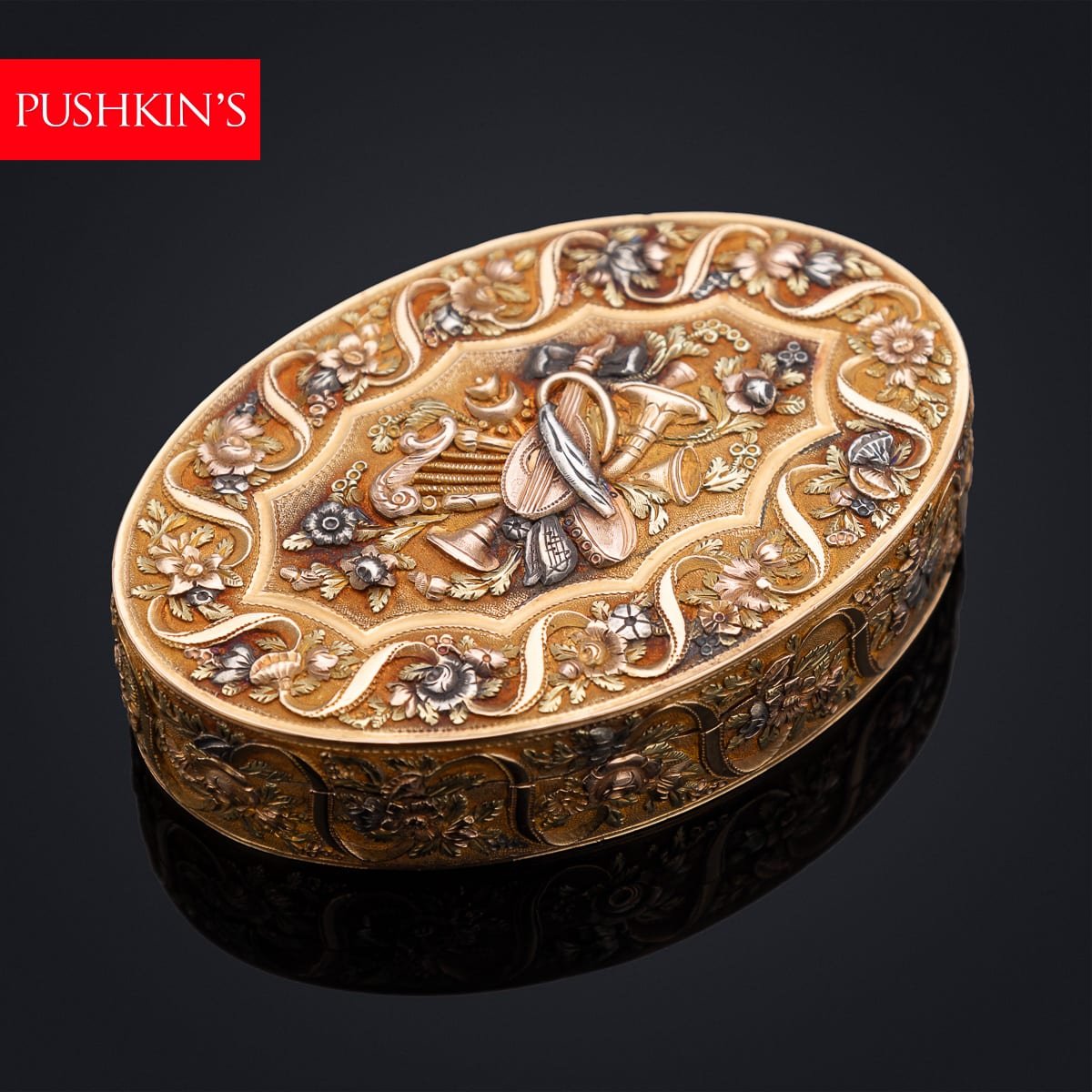
Antique early-19th Century Continental 18k three-colour gold oval snuff box, the cover finely decorated in rose, yellow, and platinum with a central musical trophy composed of instruments and sheet-music motifs, surrounded by scrolling ribbonwork and dense floral garlands in varicolored gold. The sides are similarly enriched with alternating ribbon and flower swags, and the interior is plain polished gold.
Hallmarked on the inner rim "730", likely a fineness mark or inventory number.
Reference Number: A00183

A beautiful red leather "Joe" lounge chair by De Pas, D’Urbino, Lomazzi for Poltronova, covered in gorgeous soft red leather signed with artist embossed signatures, Poltronova brand logo and 'JOE' embossing. While this is considered a chair, it is large enough to seat two in loveseat fashion or deep enough to sink into and enjoy similar to a chaise.
Reference Number: B10127

Antique 19th Century French bronze, expertly modelled as a panther in mid hunt, sinking its teeth and claws into a stag. The piece bears a brown and green patina and is signed to the base ‘BARYE’. (Antoine-Louis Barye (1796–1875). A French sculptor renowned for his dynamic and expressive animal bronzes, often hailed as the master of animalier sculpture.
Trained initially as a goldsmith, Barye developed an extraordinary eye for anatomical precision and movement. His works combined realism with dramatic composition. Barye exhibited widely at the Paris Salon, influencing generations of sculptors and elevating animal sculpture from decorative art to a respected fine art form. His bronzes remain highly sought after today for their technical mastery and vivid portrayal of the natural world.
This particular piece has been published. Bibliography: M. Poletti, A. Richarme, Barye, Catalogue raisonné des sculptures, Gallimard, 2000, no. A81 (1). A81 p. 215.
Reference Number: A00101
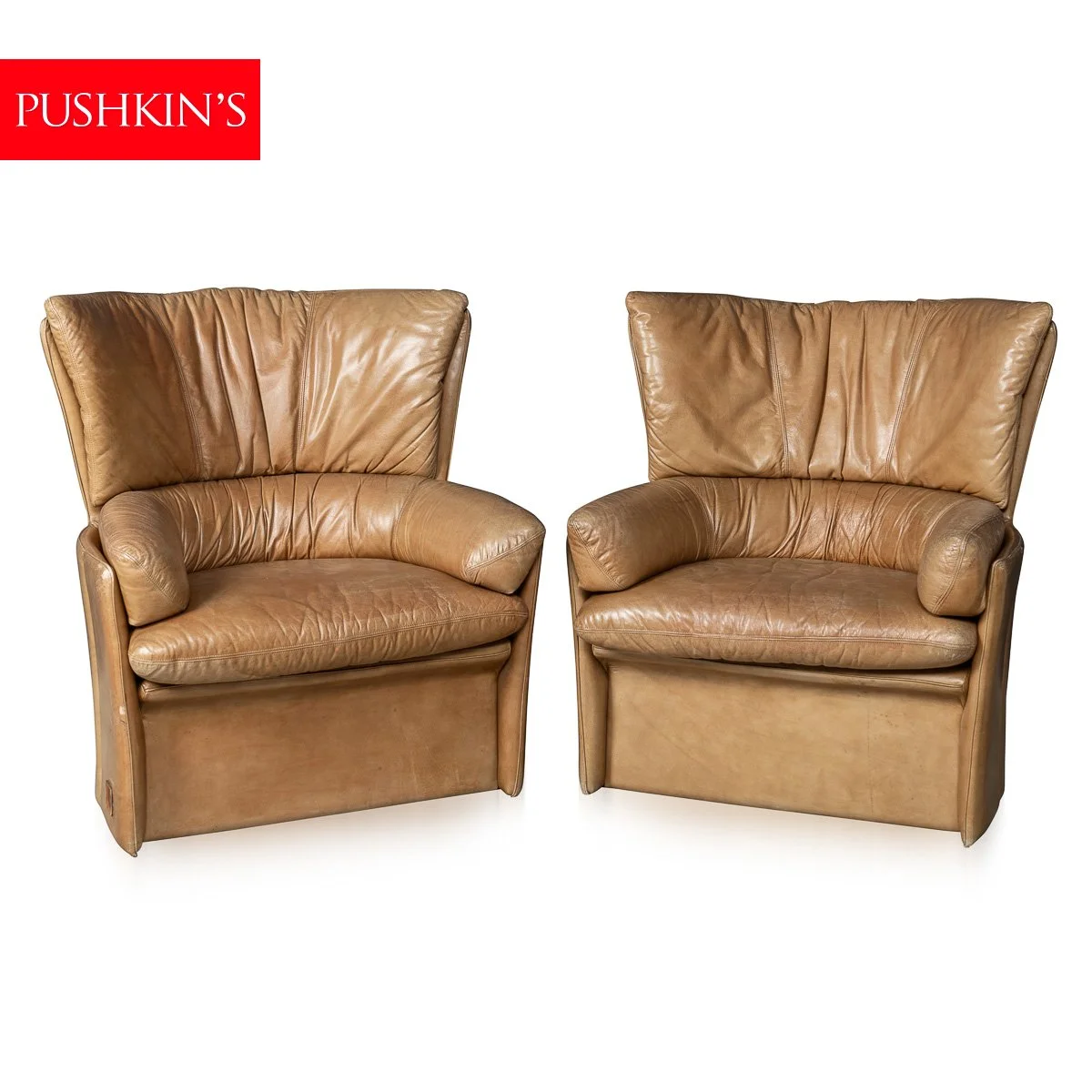
Pair of brown leather armchairs, model Ventaglio (fan), by Lev & Lev, Italy, circa 1970. These sculptural armchairs take their name from the Italian word for “fan,” referencing the distinctive flared design of the seat and backrest which opens outward in a bold, inviting shape. Upholstered in supple brown leather with deep channel tufting, the chairs combine comfort with a strong sense of 1970s Italian style.
Lev & Lev was known for producing high-quality furniture that pushed the boundaries of form while maintaining a focus on material and finish. This pair exemplifies the studio’s flair for creating pieces that are both functional and visually striking, perfect for a modern or eclectic interior.
Reference Number: B11486

A beautiful “Soriana“ leather sofa by Tobia Scarpa for Cassina, made in Italy around the latter part of the 20th century. Finished in a very rare cognac colour leather, it is lovely way to bring colour and elegance to any interior setting, working well with any room. An easy and practical way of bringing mid-century design chic to a home.
Reference Number: B10142d

A 21st Century 24 carat gold plated solid silver Ayrton Senna statue, weighing an impressive 3.3 kilos, commissioned by his family to mark the 20th anniversary of his passing in 2014. It was created by the Brazilian artist Iguti, known for producing racing memorabilia over several decades. The figure features the Marlboro sponsorship on Senna’s overalls and was issued as a strictly one off production. Approved by his mother, Dona Neide, the statue served as an official trophy at selected racing events across Europe and South America.
Rubens Barrichello, Lewis Hamilton and Sebastian Vettel were each presented with an example and were visibly moved upon receiving it. TV Globo famously awarded one to Hamilton ahead of the Brazilian Grand Prix; footage of the presentation remains widely shared online. This piece stands as a tribute to the life, career and legacy of one of Brazil’s most celebrated sportsmen and a driver many still regard as the greatest in Formula One history. It is accompanied by a certificate of authenticity, a certificate confirming the gold plating, and a fitted wooden box signed by the artist. An exceptional acquisition for any serious Formula One or Ayrton Senna collector.
Reference Number: C11908

Antique early 20th Century monumental sized silver plated footed bowl on stand decorated throughout in the Persian Ghalamzani style. The decoration divided into a series of lobed panels enclosed by arched borders, each engraved with scrolling foliage, arabesques and figural scenes depicting stylised animals with a fine textured ground.
The same style decoration is also found on the large tazza. Both pieces display an exceptional level of craftsmanship, characteristic of traditional Persian metalwork of the period.
Reference Number: JA00171

A whimsical and highly decorative umbrella stand by Fornasetti, Italy, dating to the late 20th century. The design features a charming trompe-l’œil stack of richly bound books with a grey cat perched on top, its paws and tail playfully integrated into the composition.
Executed with Fornasetti’s signature attention to detail and narrative imagery, this piece is both practical and sculptural. A statement addition to any hallway or interior space.
Reference Number: B12029

A spectacular palm tree floor lamp designed by Christian Techoueyres for Maison Jansen, France, circa 1970s. This iconic sculptural piece embodies the glamour and theatricality associated with Maison Jansen’s high-style interiors.
The lamp is formed as a stylised palm tree, with a textured trunk rising from a square black planter-style base framed in brass. The canopy is composed of layered, hand-cut and shaped brass fronds, arranged in dramatic tiers to create a full and opulent crown. When illuminated, the concealed light sources within the foliage produce a warm, golden glow that filters through the overlapping leaves, enhancing the depth and richness of the gilt surface.
Christian Techoueyres collaborated with Maison Jansen during the 1970s, producing bold, sculptural lighting that reflected the house’s signature blend of classicism and Hollywood Regency glamour. Maison Jansen, founded in Paris in 1880, was one of the most prestigious decorating firms of the 20th century, renowned for furnishing palaces, embassies, and elite private residences worldwide.
This palm lamp is a striking statement piece, both functional lighting and decorative sculpture, perfectly suited to sophisticated interiors.
Reference Number: B12013
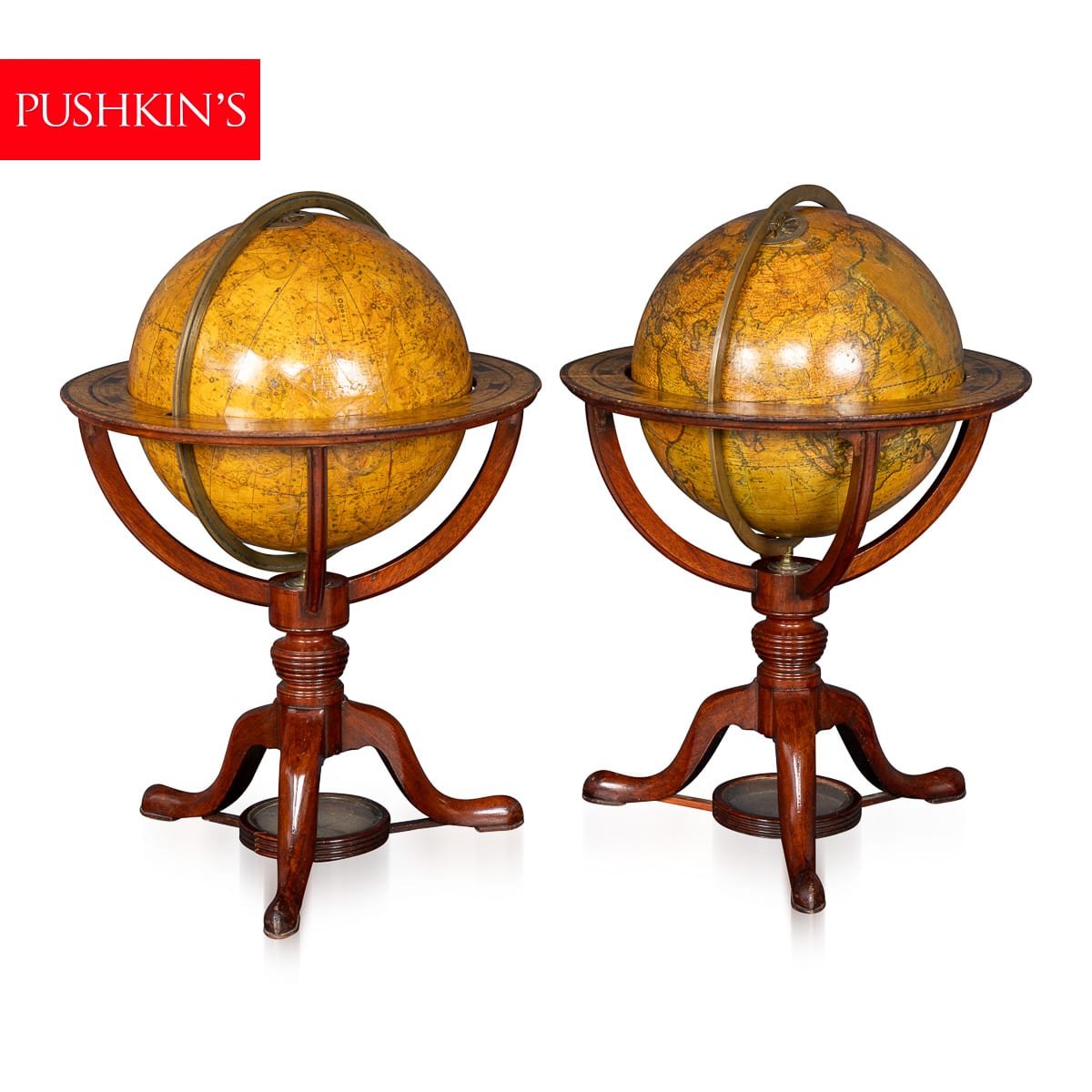
An exceptional pair of Cary’s 12-inch terrestrial and celestial globes, published in 1821, and raised on elegant mahogany stands. Produced by the renowned London cartographers Cary, these globes represent the height of early 19th-century English scientific craftsmanship and decorative refinement.
Each 12-inch sphere is mounted within a brass meridian and set into a circular horizon ring applied with printed calendar and zodiac scales. The globes are supported on finely turned mahogany columns terminating in tripod bases, united by stretchers centred with inset magnetic compasses. The terrestrial globe details the known geography of the period, while the celestial globe is richly engraved with constellations and astronomical figures typical of the era.
This distinguished pair is reputedly from the collection of Lord Bamford, further enhancing their provenance and desirability. Decorative yet scholarly, they make a superb statement in both traditional and contemporary interiors.
Reference Number: B12022
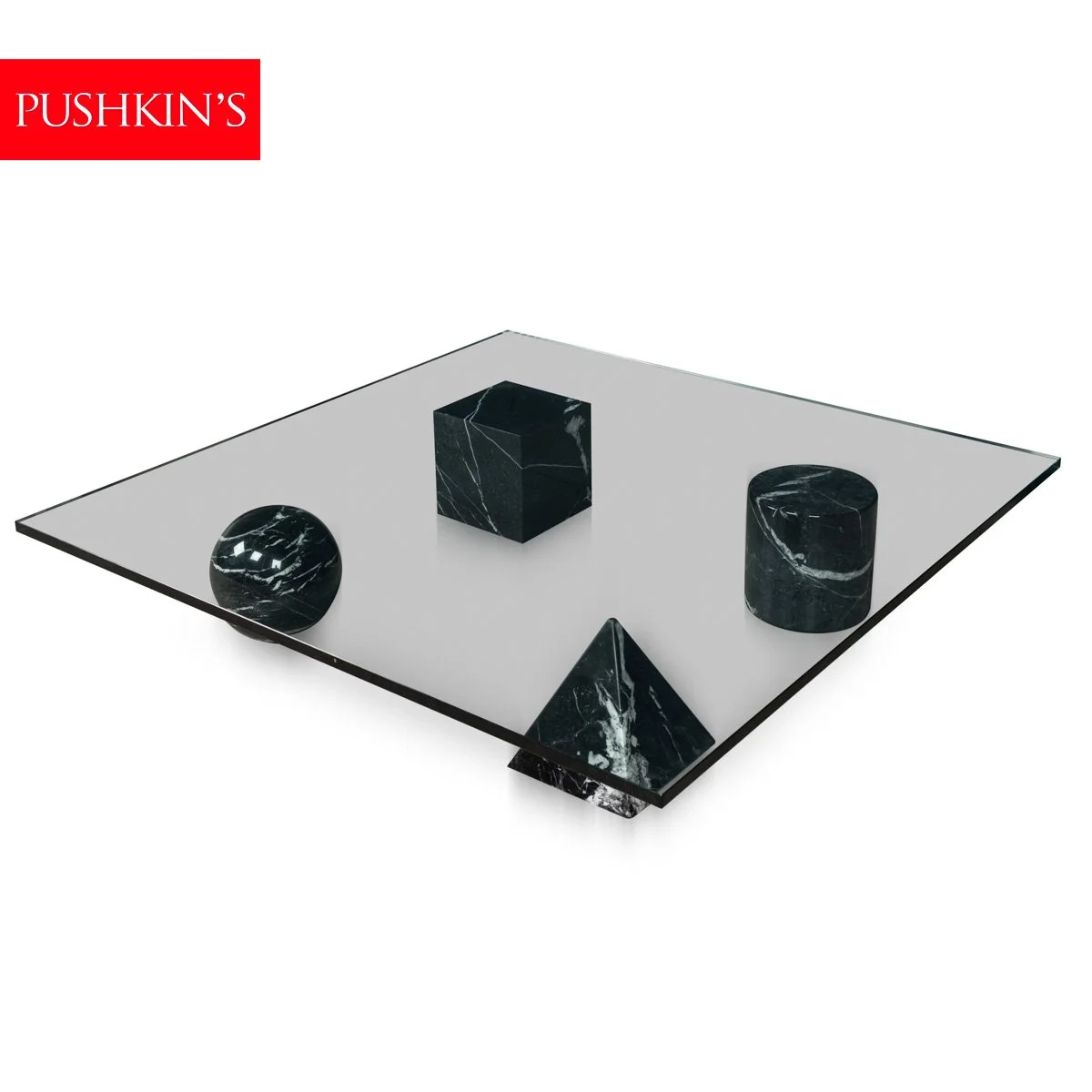
An iconic ‘Metafora’ coffee table designed by Lella and Massimo Vignelli for Castigliani, Italy, circa 1980. A celebrated example of postmodern Italian design, the table features a thick square glass top resting on four sculptural marble geometric forms, a sphere, cube, cylinder, and pyramid, each beautifully veined in contrasting tones.
The interplay between pure geometric volumes and the floating transparency of the glass top creates a striking architectural statement. Both functional and conceptual, this design has become a recognised modern classic and remains highly sought after.
Reference Number: B12057

A rare and impressive life-size wooden artist’s lay figure, French, dating to the second half of the 19th century. Beautifully carved with well-defined anatomical form, the figure features articulated limbs and notably detailed, fully articulated index fingers (an unusual and highly desirable feature).
Reference Number: B12023

A fine pair of Victorian hobnail cut crystal decanters, complete with their original fitted wooden presentation box and key. Dating to the 19th century, each decanter is richly cut with an all-over hobnail pattern, creating a striking textured surface that beautifully refracts the light.
Both decanters retain their original faceted crystal stoppers, complementing the crisp geometric cutting of the bodies. The accompanying original box is crafted in figured wood with contrasting lighter wood stringing and edging, and fitted with period hardware. The interior is lined and designed to securely house the decanters. The presence of the original key further enhances the rarity and desirability of the set.
An elegant and increasingly scarce complete Victorian set, ideal for display or refined entertaining.
Reference Number: B12030

Antique 19th Century French pair of Baccarat ormolu mounted cut glass vases with enamelled gold inclusions ‘The Jokelson Vases’. The cut glass vases are of circular baluster form, each made in three sections connected by two chased gilt bronze mounts. The body of each vase has deep diamond cutting and to the front an oval lens shaped reserve embellished with an enamelled gold inclusion depicting a naturalistic bouquet comprising, amongst other flowers, roses, tulips, pansies, convolvulous and asters.
The vases have a waisted neck cut with panels which opens to an everted rim cut with fine fluting. The vases stand on fluted socles resting on square stepped bases. These well known vases were the crowning glory of Paul Jokelson’s celebrated collection of paperweights and paperweight associated glass. They represent the highest achievement of this genre of glass manufacture and as such were on loan to The Corning Museum of Glass from 1995 to 2001.
Provenance: These Baccarat vases have an important exhibition history and were lent to the Corning Museum of Glass in Corning, New York State, where they were exhibited for a number of years. Founded in 1951, the Corning Museum of Glass is internationally recognised as one of the foremost institutions devoted to the art, history, science and technology of glass. Its collection comprises more than 50,000 glass objects spanning approximately 3,500 years, making it the largest collection of glass objects in the world. The vases’ association with such a distinguished institution adds considerably to their provenance and historical interest.
Reference Number: NS11567

Ayrton Senna’s final helmet design marks the beginning of his partnership with Williams-Renault, a combination widely expected to define the 1990s and further cement his position at the very summit of Formula One. Many believed he was poised to secure a fourth world title in 1994, with further championships likely to follow, potentially surpassing future records. Even Michael Schumacher acknowledged after Adelaide 1994 the significance of their rivalry and the scale of the challenge Senna represented. This helmet stands as a tribute to the legendary status Senna attained, a reputation that grew immeasurably following his tragic death at Imola in 1994. From that moment, his influence extended far beyond statistics. His intensity, conviction and rare magnetism left an imprint on the sport that remains unmatched, and perhaps unrepeatable.
Produced by Sid Mosca, the helmet is presented in its original box, mounted on a commemorative black base with an acrylic cover, and accompanied by a certificate of authenticity corresponding to the edition number on the reverse. Notably, it retains the correct beige velvet interior, faithful to the 1994 race-used specification, unlike many examples on the market fitted with a black lining. Thirty-one years on, this remains an essential acquisition for the serious motor racing collector.
Reference Number: C11727

A 21st Century sumo sized limited edition hardback Annie Leibovitz by Annie Leibovitz, Keith Haring edition book on stand. Hand signed by Annie Leibovitz to the title page. It is in as new condition and released in 2014.
Reference Number: A00196

A 20th Century British showroom display bronze of the legendary Rolls-Royce mascot which was designed by Charles Sykes R.A, the dark patinated bronze sculpture is set on a shaped marble plinth. Signed by the artist Charles Sykes No.13, - later cast. The Spirit of Ecstasy, also called Eleanor, Silver Lady, or Flying Lady, was designed by Sykes, a graduate of London's Royal College of Art, and carries with it a story about secret passion between Montagu, second Baron Montagu of Beaulieu after 1905, a pioneer of the automobile movement, and editor of The Car Illustrated magazine from 1902, and the model for the emblem, Eleanor Velasco Thornton.
Reference Number: A00091