

Introduction to Chinese Export Silver

19th Century Chinese Export Wang Hing Silver dragon centerpiece bowl, large size and exceptional quality, oval form, the double walled body is profusely chased in relief with dragons chasing the flaming pearl amongst clouds and flowers, the foot embellished with bamboo leaves and flowers, each side is applied with a intricately modelled dragon handle, outstanding quality. Hallmarked Chinese silver (90 for 900+ standard), Mark "WH" for Wang Hing.
Reference Number: A2789
"Chinese Export Silver" refers to the silver made in China, mostly from late 18th Century to mid 20th Century for the Western clientele.
When in late 18th Century the commercial exchanges between East and West started to flourish, the demand for fine Chinese products increased significantly.
Merchants and Western tourists visiting China soon realised that they could commission silver items in China for a cheaper price than in their own home countries. In fact, the earliest pieces are often made in Neo-classical or Georgian style, almost indistinguishable from those made in Europe if not for a surprisingly heavy weight. Especially in this first period the silver workshops remained anonymous and the Chinese silversmiths often used to mark silver with pseudo English marks, to imitate the English hallmark system.

Early-18th Century Chinese Qing Dynasty silver-gilt pair of tea cups and saucers, repousse and fine chased work, cast cups dipicting people of nobility surrounded by blossom trees and pogodas on finelly tooled ground, mounted with unusually shaped cast scroll handles. The saucers beautifully hand engraved and each applied with four convext sections dipicting birds amongst blooming flowers, such recuring scenes were favourite of Chinese court and painters of the Ming Dynasty and would continue to be used in later Chinese works of Art.
REFERENCE NUMBER: A5284
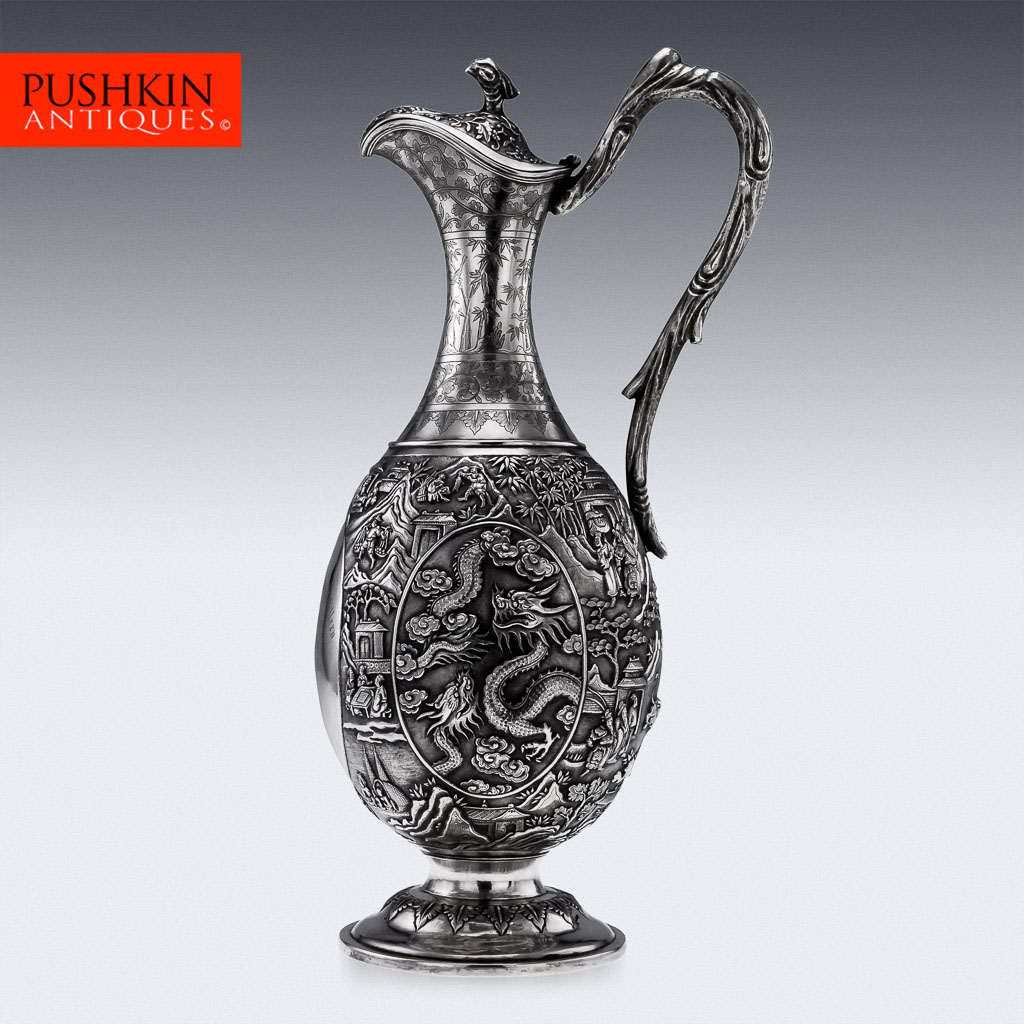
19th Century Chinese Export Silver trophy ewer, impressive and exceptionally fine, baluster form, the body showing a compendium of the finest techniques and styles used in Chinese Export Silver: the domed circular base chased with stylized leaves, the round body featuring an oval medallion on each side depicting flying dragons in relief amongst clouds, surrounded by a densely populated landscape with mountains, buildings and trees, depicting a great number of figures and animals, the neck engraved with decorative stylized naturalistic patterns, in a style that had strong influence on the Victorian decorative art with the so-called "aesthetic movement", the handle naturalistcally modelled imitating a branch, chased hinged cover surmounted by a similarly shaped finial.
The decoration is extremely crisp and detailed, the ewer shows almost all the patterns and decorative techniques used in Chinese Export Silver, like engraved stylized scrolling foliage, bamboo leaves, dragons in relief, the naturalistic branch-like handle, the most popular and sought after village scenes. Hallmarked Chinese silver (90 for 900 standard), Maker's mark "WH90" for Wang Hing.
Reference Number: A3263
From the second half of 19th Century, with the growth of the market and the subsequent interest of the Western clientele toward the Chinese art, Chinese silversmiths started to introduce traditional Chinese decorative motifs, such as dragons, bamboo leaves, plum flowers and Chinese landscapes. The result is a fascinating blend between East and West: traditional European objects and tablewares such as tea and coffee sets, bowls, vases and flatware were decorated with distinctively Asian designs and symbolic forms. Due to the growing popularity of their craftsmanship, Chinese silversmiths began to use their own marks and brands such as Wang Hing, Da Xing, Tuck Chang or Luen Wo became proper statements.
Not only wealthy American and European families started to collect Chinese Export Silver: among the earliest and most avid collectors it is worth to mention Catherine the Great of Russia and Queen Charlotte, wife of King George III of England.
The success of Chinese Export silver became a long-lasting one, interrupted just with outbreak of the First World War and the subsequent influence of Japan over China.

19th Century Chinese solid silver exceptionally large and unusual water ewer, the straight body beautifully chased along the main body with a rising sun amongst mountains and river landscape, the foot, lid and spout intricately engraved with flowers and birds
Hallmarked with Da Xing mark.
Reference Number: A4626

19th Century Chinese Export silver filigree and enamel table mirror, very large and exceptionally fine, resting on four fish-shaped feet, applied with a blue and green enamelled filigree frame, intricately crafted creating flowers and leaves, the back and the side of the mirror is also finely decorated with enamelled filigree-work. Hallmarked with Chinese marks (900+ silver standard), year about 1870-90, Maker's mark for Da Xing.
Genuinely antique Chinese enamelled filigree pieces are exceptionally rare, most of them are now in museums or important private collections. The mirror here presented appears to be exceptional for size, rarity and quality, probably produced for a wealthy Chinese clientele and not for export.
Reference Number: A3413
Chinese Export silver has been rediscovered by scholars and collectors in the 1970s thanks to the research of H. A. Crosby Forbes, John Devereux Kernan, Ruth S. Wilkins (‘Chinese Export Silver 1785 to 1885’, Milton, Museum of the American China Trade, 1975) and more recently Adrien von Ferscht ("Chinese Export Silver 1785-1940: The Definitive Collectors' Guide")
Nowadays its market is growing fast and steadily attracting buyers from both the East and the West.