

Important Silversmiths - Hermann Bohm
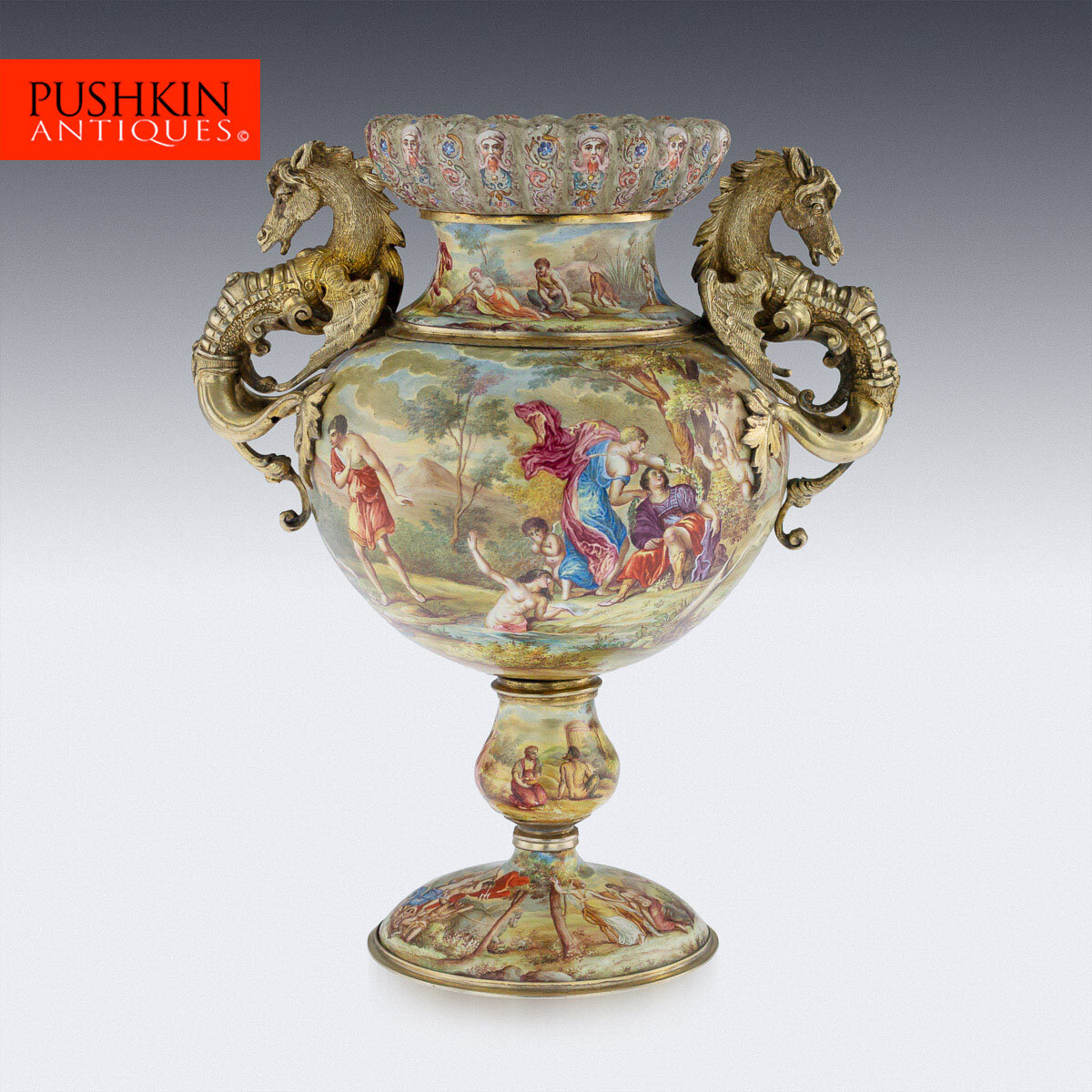
Antique late-19th Century Austrian exceptional solid silver gilt & enamel twin handled vase, standing on an oval base, shaped bulbous stem and the body hand painted with classical allegorical scenes, sides applied with cast hippocampus handles. Hallmarked Austrian-Hungarian assay city letter A (Vienna), Makers mark HB (Hermann Bohm)
Reference Number: A5755
Hermann Böhm (also spelled Boehm) was a famous silversmith and enameler working in Vienna between the end of the 19th century until 1922. Originally from Hungary, he moved to Austria in 1866 and started working as a silversmith with his father-in-law Ludwig Politzer.
He specialised mainly in vases, table ornaments and novelty objects in the Renaissance revival style and inspired by the antique. In Germany and Austria the neo-Renaissance style developed in the final decades of the 19th century alongside the growth of a national identity, and took the name of Historismus or Historicism.
By the time of the Vienna International Exhibition in 1873, Bohm was already considered one of the most prominent Austrian enamelers, among the likes of Hermann Ratzersdorfer, Ludwig Politzer, Rudolf Linke and Karl Bank.

19th Century pair of Austrian Silver mounted enamelled candlesticks, exceptionally fine, each resting on a circular domed foot, the silver rims beautifully champleve' enamelled, the stem embellished with two bands applied with figures and enamelled, the body beautifully enamelled with classical scenes within medallions. Hallmarked Austrian silver (900), "A" for Vienna, Maker's mark "HB" for Hermann Bohm.
Reference Number: A3489
The very high quality of his silver-mounted enamelled artworks received international acclaim at the Exposition Universelle in Paris 1889. He also exhibited at the International Fair in Paris in 1899 receiving international acclaim.
On that occasion, the British correspondent for the London trade journal, the ‘Jeweller & Metal Worker’, spent these words about his artworks: ‘Böhm ... indeed counts its chief glory to give perfect reproductions of grand medieval pieces, rich of gems and enamel of many colours, while even his modern specimens of the goldsmith’s and jewellers’ art are so quaint and old-world in time and feeling that they have the charm of heirlooms … the effect is gorgeous without being barbaric ...’