

An Introduction to The Russian Kovsh

20th Century Imperial Russian silver & cut-glass Pan-Slavic style kovsh. with a curling mount prow, the handle cast and chased depicting a Firebird from the fable by Alexander Sergaiavich Pushkin, the body cut with a diamond and snowflake patterns.
Hallmarked Russian 84 silver (875), St-Petersburg, year 1908-1917, Maker's mark in Cyrillic for Grachev Brothers.
Reference Number: B5946

20th Century Imperial Russian Faberge silver kovsh, of traditional shape with plain polished surface, the cartouche shaped handle set with a silver rouble depicting Catherine the Great.
Hallmarked Russian silver 84 (875 standard), St-Petersburg, Assay master Yakov Lyapunoc active 1898-1903, Maker's mark J.W for Jenny Wakeva, K,Faberge in Cyrillic beneath an Imperial warrant.
Reference Number: B6325
The Russian silver kovsh with vivid polychrome enamels is a widely known image of Russian tradition and nowadays a very sought after object by collectors worldwide. Nevertheless few know that Russian kovsh has its origin in the 10th century.
In its essence, the kovsh is the most ancient form of Russian festive drinking vessel. Standing at the center of the table during feasts, the kovsh was meant to serve the main Russian drinks: mead, beer and kvass.
Early Russian kovshes were carved from wood into the oval form similar to lodge or water birds with one or two handles. The size came in an enormous range: from the smallest one for only one gulp to the large kovsh containing up to four buckets of drink.
It is believed that the first Russian silver kovsh appeared in Novgorod only in the 14th century. There, in the North of Russia, the traditional wooden form was reproduced in silver and gold. The most ancient find is considered to be the surviving Russian silver kovsh, which belonged to Novgorod's Archbishop Euphimiy and dated to the last quarter of the 14th century.

20th Century Imperial Russian gem set 14k gold Royal kovsh, repoussé and chased with panels of rococo scrolling foliate cartouches enclosing rubies flanked by diamonds on the sides and back, the front mounted with a diamond-set cypher of Nicholas II, the handle with a jewelled Imperial crown.
Hallmarked Russian gold 56 (585 standard), St-Petersburg, Fabergé in Cyrillic, scratched inventory number 14819, Maker's mark W.H. for Henrik Wigstrom.
Reference Number: A5651

20th Century Imperial Russian silver & shaded cloisonne' enamel Kovsh, of traditional oval form, with raised prow and hook handle, the body beautifully decorated with various shaded polychrome cloisonne' enamel with stylised scrolling foliage and geometric motifs.
Hallmarked Russian silver 84 (875), Moscow, year 1908-1917, Maker in Cyrillic GA for Grigory Sbitnev.
Reference Number: A6069

19th Century Imperial Russian Faberge carved band agate kovsh set with a gold plain rim and a scroll handle, adorned with bright red garnets.
Hallmarked Russian 56 gold (585), St-Petersburg, Maker EK for Erik Kollin
Reference Number: A5468
Later in the 16th and 17th centuries, the Novgorod silver kovsh style was perfected by the Moscow masters, who at first had just been copying the originals. But in the 17th century the design of Russian kovshes has notably evolved. The austere kovsh designs evolved into complex pieces with peculiar decorations, intricate ornaments and an abundant usage of gemstones.
In the late 17th, 18th and early 19th centuries the solemn form of the Russian kovsh acquired a new purpose by becoming the state award, that was traditionally gifted, on behalf of the Russian Tsar, to the subjects that made the highest contribution to the welfare of the country.
Silver-gilt kovshes decorated with refined engravings, golden details and hardstones became the honorable Russian Imperial distinction. The size of the ladle was strictly affected by the social status of the awarded, his merits and his position.

Antique 19th Century Imperial Russian silver-gilt & plique-a-jour enamel kovsh. Oval, with raised shaped trefoil handle, decorated with exotic birds, flowers and floral scrolls in red, blue, pink, green and white within red and twist wire borders.
Hallmarked Russian silver 84 (875), Moscow, year 1890, Maker NX for Ivan Khlebnikov.
Reference Number: A6312

20th Century Imperial Russian silver presentation kovsh, sides applied with chrysoprase and carnelian cabochons within reed and rope-twist borders, the cartouche-form handle inset with a silver half rouble coin of Peter I dated 1720. Hallmarked Russian silver 84, Maker's mark for Jenny Wakeva.
Reference Number: B4998
In the late 19th century, the resurgence in popularity of Old Russian culture, free of Western influence, inspired the Russian artistic circles, including the prolific community of silversmiths, goldsmiths and enamelers. Fabergé and other Russian silver artisans revived numerous enamel techniques and started to apply them generously on their creations.
The multi-colored cloisonne and guilloché enameled kovshes with traditional Pan-Slavic motifs made by Feodor Ruckert inspired the greatest silver workshops for a resurgence of the Russian kovsh as a pure object of art.
The plique-a-jour kovshes by Pavel Ovchinnikov, champleve enamel pieces by Ivan Khlebnikov, silver gilt kovshes with filigree enamel and precious gemstones by Maria Semeonova represented a traditional housewarming or work-anniversary gift in Imperial Russia and became an integral part of the Imperial Russian heritage.

20th Century Imperial Russian Silver and shaded cloisonne' enamel Kovsh.
A beautifully Pan-Slavick shaped handle and body, the interior and exterior decorated with polychrome flowers and scrolls against an ivory ground, surrounded by a rope twist boarder and blue beads along the rims.
Hallmarked Russian silver 84 (875), Moscow, year 1898-1914, Maker's mark in Cyrillic NC for Ivan Saltykov.
REFERENCE NUMBER: A4254

20th Century rare Imperial Russian silver gilt and cloisonne' enamel kovsh, of traditional form on plain circular foot with raised prow and hook handle, beautifully decorated with various multi-coloured polychrome cloisonne' enamel with stylised scrolling foliage and wirework.
Hallmarked Russian silver 88 (915 standard), Moscow, year 1908-1926, Maker's mark in Cyrilic F.R for (Feodor Ruckert, important Faberge work-master).
Reference Number: A4299
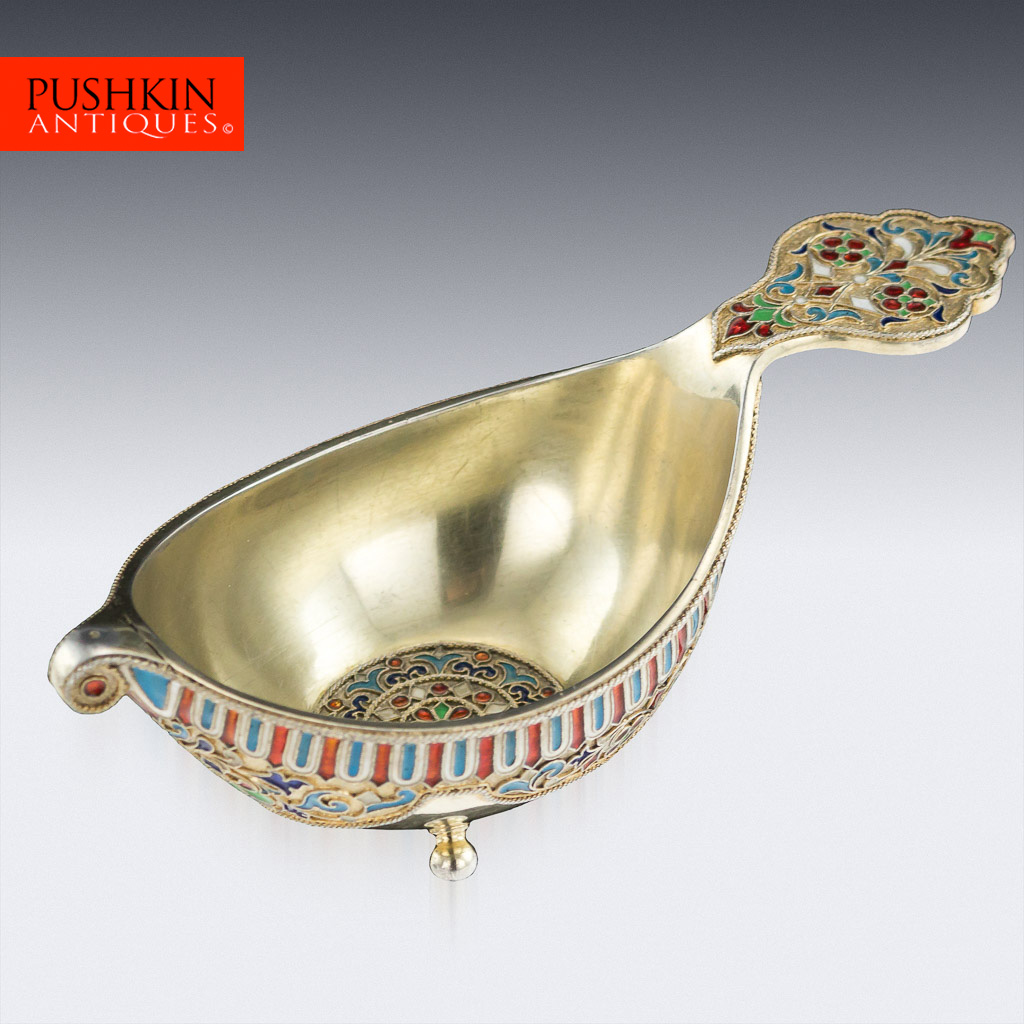
19th Century Imperial Russian Silver and cloissoné enamel Kovsh, the bowl with a wide rim border of vibrant polychrome lobes and leafy flourishes, the interior decorated with a round floral motifs, cartouche-form handle, volute scroll prow, standing on three ball shaped feet. Hallmarked Russian silver 88, Maker's mark for Ivan Khlebnikov.
Reference Number: A4209