

Victorian Fine Dining
During the reign of Queen Victoria, the dinner party became an important part of social life, especially so for the Upper and emerging middle-class families, they began to pay great attention not only to the meals but also to the ceremony and theatrics surrounding them.
Once accepted, the invitation to the dinner could not be ignored or cancelled. "Death or infectious disease is the only justifiable excuse for failing one's host and hostess" (Etiquette for Women: A Book of Modern Modes and Manners, G. R. M. Devereux, C.A. Pearson, 1902, p.52).

19th Century Victorian silver set of twelve dinner plates, each of shaped-circular form with gadrooned borders. Each border is engraved with a family crest of Sir Glynne Earle Welby-Gregory 3rd Baronet. (1806-1875), who succeeded his father in 1852.
Hallmarked English silver (925), London, year 1854 (T), Maker's mark ISH for John Samuel Hunt.
Reference Number: C6585
The fine dining etiquette was elevated to a true art form. At the host's house, the guests were invited firstly to the reception room and later escorted to the dining room. The dining room became one of the main rooms in the house. Furnished with the large table set, buffets and sideboards, usually the room was generously decorated with mirrors and paintings on the walls.
The hosts sat at the opposite ends of the table, while the guests would take their places, according to the cardholders near every seat. Women sat first, followed by the gentlemen. If the hostess or another lady would stand up, all the gentlemen should stand up as well. Once sat, the guest should place the napkin on his or her knees, as the sign of starting the dinner. When the dinner was over, all the guests were accompanied to the drawing room to continue the conversation, play cards or even dance.
In the 19th century, the service a la Russe (service in the Russian style) came in practice. This manner of service meant that the courses had been portioned and arranged on the plates in the kitchen beforehand, the servants brought them to guests in a strict sequence. The dinner could consist of 14 courses and last at least an hour. This fashion allowed to clear up space at the centre of the table and led to the tremendous growth of table decoration importance.
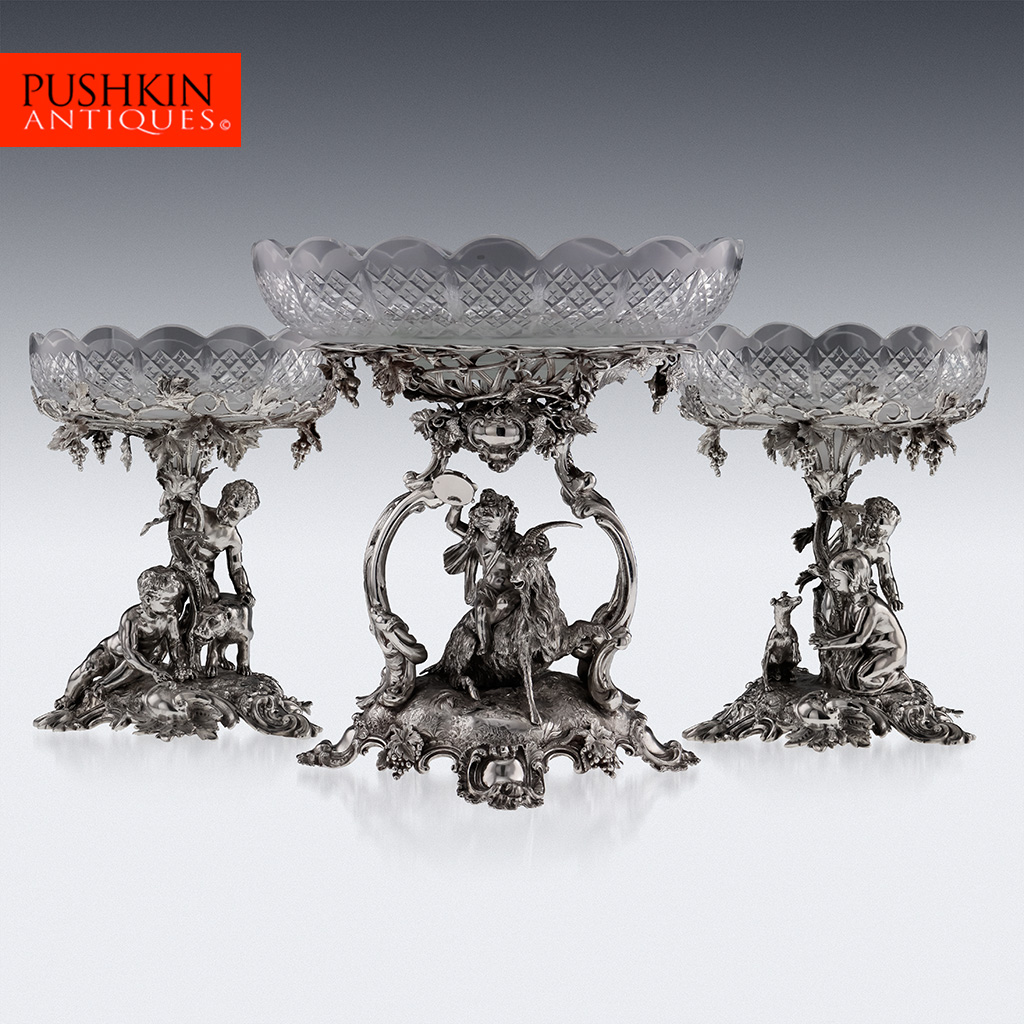
19th Century Victorian Silver matched three-piece table garniture, each piece raised on a shaped domed base supporting a pastoral scene, the central piece depicting a nude putto sitting on a goat, the lateral pieces mounted with two nude puttos playing with a dog and a panther, each piece decorated with an applied and detailed grapevine decoration, with suspended grapes issuing a latticework basket and set with fitted glass bowls. Hallmarked English silver (925), London, the central piece year 1857 (b), Maker's mark SSWN for Stephen Smith & William Nicholson, the two lateral pieces year 1856 (a), Maker's mark "EB&JB" for Edward & John Barnard.
Impeccable centrepieces, accompanied by gilded candelabras or flower arrangement at the sides, had become very popular articles for table setting at the Victorian dinner.
Prominent silversmiths such as Paul Storr, Stephen Smith, George Fox and many others offered a wide range of impressive sculptural pieces, usually characterised by highly-ornamental designs and decorated with peculiar reliefs, these stunning objects were elaborated to adorn every formal ceremony.
During the Victorian era, silver flatware and cutlery had become the essential part of a fine dining table. The serving utensils, such as a vast variety of different spoons, carving knives, gravy ladles, meat forks, and many other specialized pieces, were also demanded to be made of silver with intricate carvings and scrollworks. The Victorian silver flatware sets could include up to 100 pieces.
The 19th century had become the era of the finest silverware in British history, Companies such as Garrard & Co, Hunt & Roskell, Sibray Hall & Co, Mappin & Webb produced extraordinary silver table and tea sets, cutlery and decorative table accents, such as silver napkin rings, coasters, cardholders.

19th Century Victorian silver & glass condiment set, comprising; a cruet stand, five sauce bottles and two silver lidded condiment jars, made in the 'Teniers' style, (a renowned Dutch painter), the base of the cruet stand decorated with rural scenes, standing on scroll feet mounted with peasants drinking, handles and mounts realistically modelled as tree branches. Hallmarked English silver (925 standard), London, year 1870 (p), Maker's mark IH&RR (John Hunt & Robert Roskell), stamped on the base, Hunt & Roskell late Storr & Mortimer 5723, engraved with a family crests and initials.
Reference Number: A5499
This item is eligible for the Pushkin’s Promise scheme.
Each of the numerous courses had been served not only with its own silverware set but also with a dedicated drink. Sherry was served with the soup, the sweets and the desserts; chablis - with fish meals; champagne, hock or claret - with the entrees. Most of these drinks were attributed to their special jugs and glasses. Silver and crystal drinkware was designed to satisfy the needs of every wine. Such impressive ewers and claret jugs, like those made by Charles Fox, W & G Sissons, are very sought after by collectors today.
While the excessive table setting and many of the Victorian utensils become slightly outdated nowadays, the outstanding silverware is still highly valued and recommended for the fine dining setting.