

The Timeless Artistry of Guilloche: A Closer Look
Guilloche, or engine turning, refers to the intricate geometric patterns meticulously etched into delicate materials such as wood, ivory, silver, and gold. This artistry is accomplished through the use of a lathe, a mechanical device that employs a rotating drive to turn the material against adaptable cutting tools. The later introduction of the rose engine lathe elevated the possibilities, enabling more intricate and repetitive motifs.
The historical roots of engine turning extend as far back as the 15th century, with its initial applications seen on wood and ivory. However, it was in the European courts during the 17th, 18th, and 19th centuries that engine turning gained prominence. These courts often dedicated special rooms to this craft, where the skills of artisans could be observed for both educational and entertainment purposes.

20th Century Cartier Art Deco 18 Carat gold compact, of circular form, set with diamond monogram and banquet cut diamonds push-button, both sides are inlaid with floral design champleve' creamy pink enamel and engraved sunburst motif to cover and back. The inside of the cover is set with a mirror.
Hallmarked English 18k gold (750 standard), London, Year 1935 (u), J.C (Jacques Cartier, Mansfield st, London). The top set with the monogram B.S (Beatrice Sigrist, Lady Ormerod of aristocratic White Russian descent, the mother of Princess Fredericka Ann Guirey)
Reference Number: C7917
Some of the most extraordinary engine-turned designs originated in the workshops of notable rulers, including Maximilian I of Austria, Tsar Peter the Great of Russia, Louis XV, and King James I, among many others. The practice of guilloche on metal emerged between 1700 and 1750. Its popularity reached its zenith in the mid to late 19th century, peaking between 1880 and 1930. Fabergé, in particular, became renowned for its intricate and extensive guilloche work, especially on the backgrounds of transparent enamels, creating a dazzling, gem-like luminosity and optical allure. Karl Fabergé employed this technique to craft his iconic eggs for Tzar Alexander III of Russia.
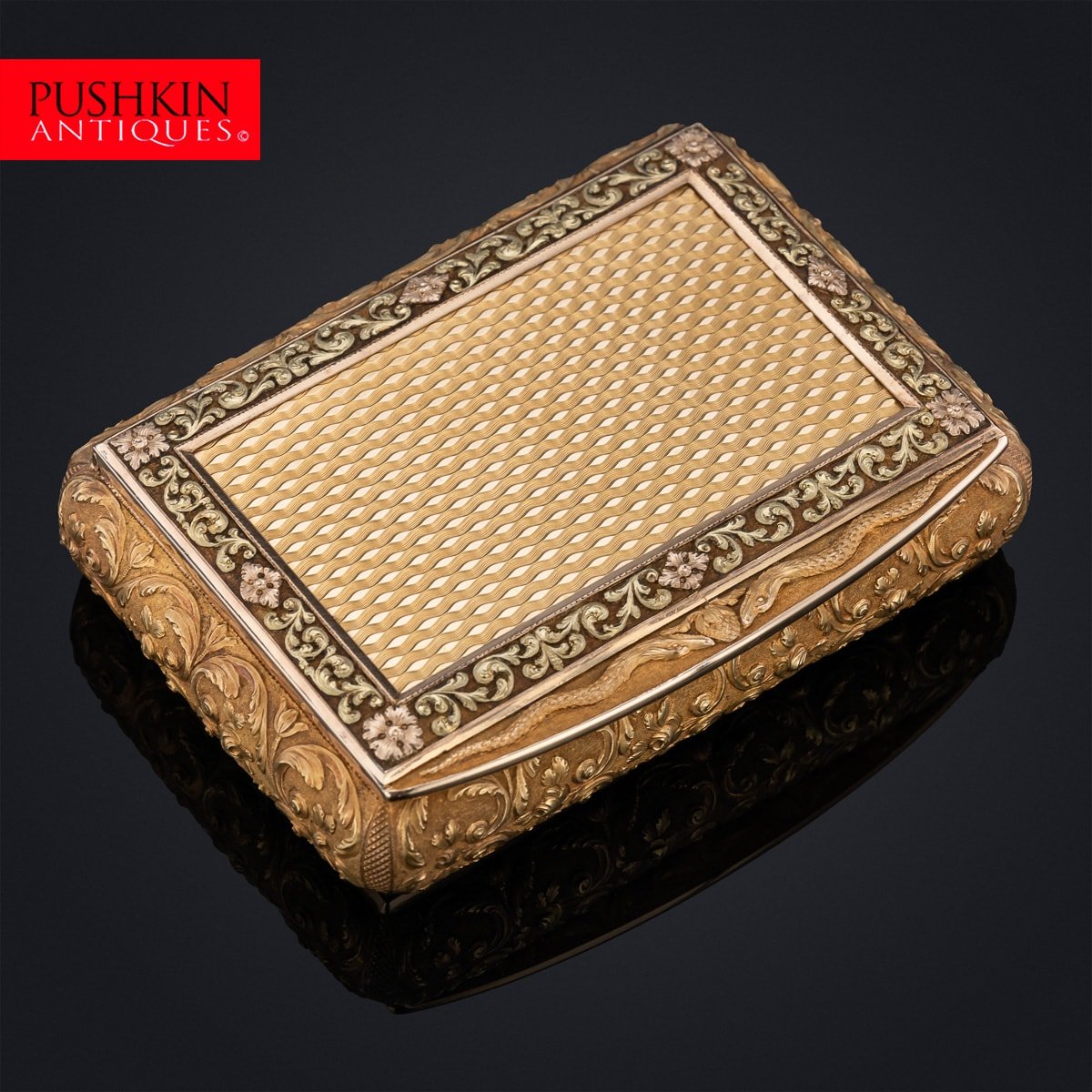
Antique mid-19th Century Swiss 18k gold snuff box, of rectangular form with rounded corners, chased and engraved throughout with scrolling folliage and rosetts, lid and base with engine turned decoration, the lid set with a three-colour gold scrolling flowers and foliage boarder on matted ground, with thumb piece engraved with a pair of mythical dolphins. Hallmarked Swiss 18k gold (750 standard), guarantee mark (used 1815 - 1881), Makers mark M&B (Bautte & Moynier).
Reference Number: A9047
The rose engine lathe meticulously carved parallel lines into the metal surface, serving as the canvas for the subsequent application of enamel. Guilloche, this beloved engraving technique, found its way onto snuffboxes, jewellery, and watches. Snuffboxes were ornamental containers designed to hold snuff, a powdered form of tobacco. In the 17th century England, inhaling or sniffing a pinch of snuff was a common practice, which later spread to other European countries. These snuffboxes were created to fit discreetly into a gentleman's jacket pocket or to be showcased on the dinner table as a symbol of wealth and prestige. The finest snuffboxes were crafted from gold and adorned with portrait miniatures, enamelling, micro mosaics, or jewels. Engine turning, with its various engraved designs, played a significant role in adorning these exquisite containers.