

Important Silversmiths – Nicholls & Plincke
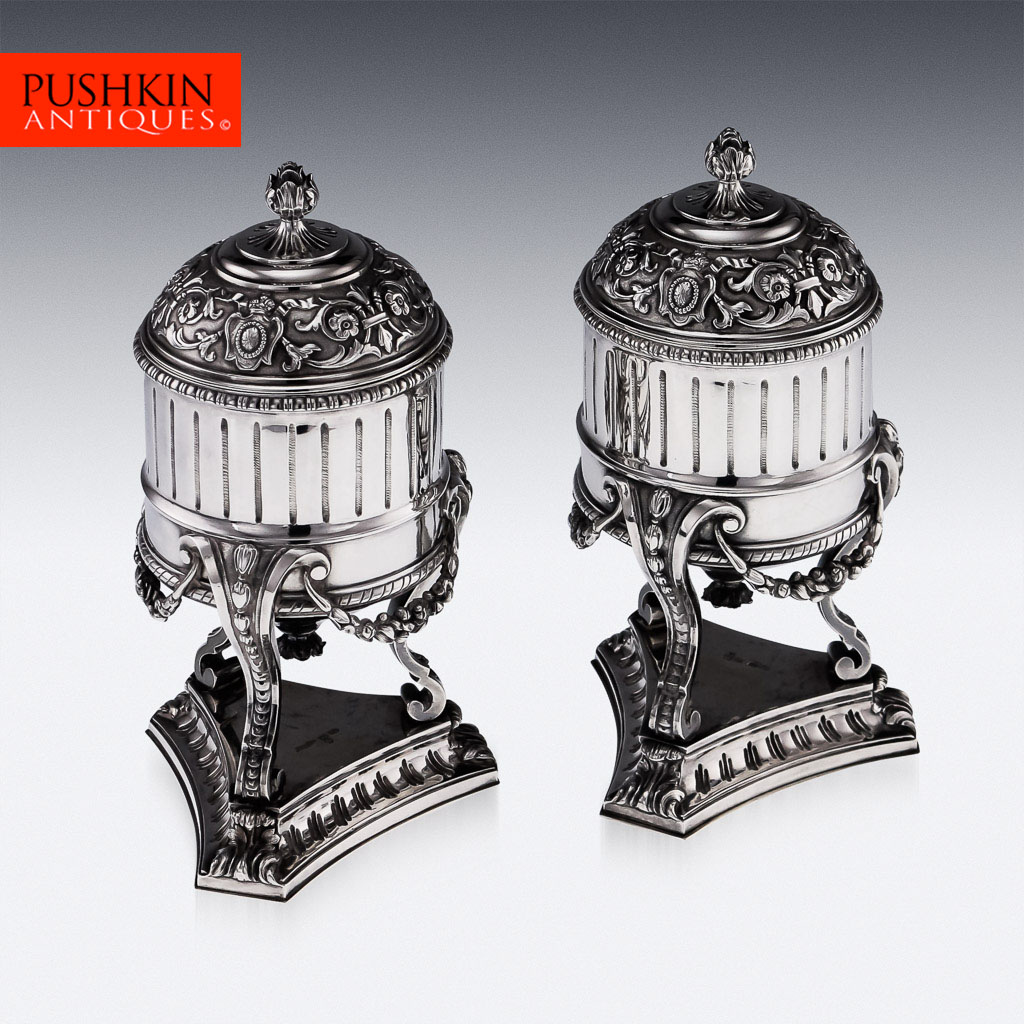
19th Century pair of Imperial Russian Silver caviar dishes / covered urns, stunning Empire style, magnificent and extremely heavy, parcel gilt, each tapered body raised on three scrolling feet resting on a triangular base, each urn surmounted by a cover decorated with scrolling leaves and flowers in relief, oval cartouche engraved with initials, cast finial.
Hallmarked Imperial Russian silver 84 (875), St Petersburg, year 1874, Assayer's mark, Maker's mark "NP" surmounted by the Imperial Warrant and "PK" for Nicholls and Plinke.
Charles Nicholls and William Plincke (in russian: Николс и Плинке) were two English men trading in St. Petersburg who were granted Russian citizenship in 1804. In 1808 they qualified as members of the first guild and in 1815 they took over the business founded in 1876 by John Pickersgill. They initially traded under the name of William Plincke’s English Shop and from 1829 Nicholls & Plincke’s English Shop (1829–54).
In 1844 Nicholls and Plincke gained hereditary honorary citizenship.
The firm supplied Russian aristocracy and the Imperial Court, becoming in the 1840s one of the most exclusive silver and jewellery shops in Russia. The workshop realised the Christmas presents for the Tsar Nicholas I (1820s - 1830s) and the silversets for the dowries of the Tsar daughters. Collaborating with British workshops and local craftsmen the English Shop also supplied the malachite fireplace in the Malachite Hall of the Winter Palace and contributed to the London service of Tsar Alexander II and the Orlov service.
The firm was eventually outshone by the rise of Fabergé workshop and was closed in 1880 after facing major financial problems.