


Indian Silver
Indian silver usually refers to the silverware produced in India during the Colonial period. The first foothold of the British East India Company in India dates back to 1615. From the 17th Century onwards, rare and stunning silver pieces were made both in the Portuguese and British colonies but the sudden growth in demand for silver produced in India mainly dates to the second half of the 19th Century and mostly concerns British colonies.
This period became very lucrative for local and British silversmiths. They set up workshops and shops in the major cities of the colony and some of them remained in business long after India achieved its independence from the British Raj in 1947. The greatest peculiarities of Indian silver are quality and variety: each region had its own distinctive style, themes and forms. The technique used by Indian silversmiths is mainly the repoussé, consisting in finely chasing the chosen pattern from the underneath, creating extraordinarily decorative designs in relief emerging from a finely tooled ground. The silver objects produced during this period are usually inspired by the contemporary Victorian silverware, sometimes imitating the English designs or, more often, interpreted in the characteristic local style. The most common items are salvers, trays, jugs, ewers, cups, beakers, boxes, vases, tea caddies, goblets, scroll holders and, more than anything, tea ware and bowls.

19th Century Indian Colonial silver centerpiece, in a form of a processional elephant and rider, supporting a dish and trumpet vase above his head. The detailed engraving is particularly crisp and ornate.
Marked O.M of Oomersi Mawji.
Reference Number: A4292

19th Century Indian Oomersi Mawji, Kutch, Bhuj, Gujarat region silver salver tray, of circular form on four ball-shaped feet, applied border, finely chased with scrolling leaves and flower pattern in a finely tooled background, typical of Cutch work and with four medallions chased with mythical and human figures in traditional dress - probably Hindu deities.
Maker's mark "O.M BHUJ", for Oomersi Mawji, the piece dates to 1880's.
Reference Number: A1824

19th Century Indian Cutch silver three piece tea set, modeled as Black Francolins standing on snakes, textured all over with a scalloped pattern and with large feathers detailed on the wings; the large francolin as teapot with its head hinging open along the beak to serve as spout and the serpent's tail entwined around its neck serving as handle with ivory insulators; small francolin with hinged head and raised wings as milk jug, the other as sugar bowl with hinged back. The base of the teapots foot is stamped O.M BHUJ.
Cutch (or Kutch) is widely regarded as the most recognisable style of Indian silver, gaining significant popularity during the Victorian era when it was imitated by prominent English silversmiths, including Elkington & Co. While Indian silver is typically unmarked, Cutch silver stands out for its intricately chased scrolling foliage and floral designs, often adorned with reliefs of animals and hunting scenes.
The most illustrious figure in Cutch silver is Oomersi Mawji, considered the greatest Indian silversmith of his time. Along with his son, he operated the highly successful Mawji & Sons workshop in Bhuj, Gujarat, which became renowned for its exceptional craftsmanship. They signed their pieces as “O.M” or “O.M BHUJI.” Mawji's work is distinguished by its unrivalled quality and imaginative designs, frequently embellished with motifs of animals, hunting scenes, and figural handles shaped like snakes, elephants, tigers, and lions. One of his most celebrated creations is an extraordinary tea service designed to resemble birds, showcasing both his artistic talent and technical skill.
During the late 19th and early 20th centuries, several other silversmiths produced silver of comparable quality in the Cutch style, adhering to the traditional foliate designs enhanced with animal motifs. Notable artisans, such as Manikrai, Mawji Raghavji, and VK, occasionally signed their pieces with their initials, contributing to the rich legacy of Cutch silver craftsmanship. The legacy of Cutch silver continues to be appreciated for its cultural significance and intricate artistry, representing a unique blend of Indian and colonial influences.
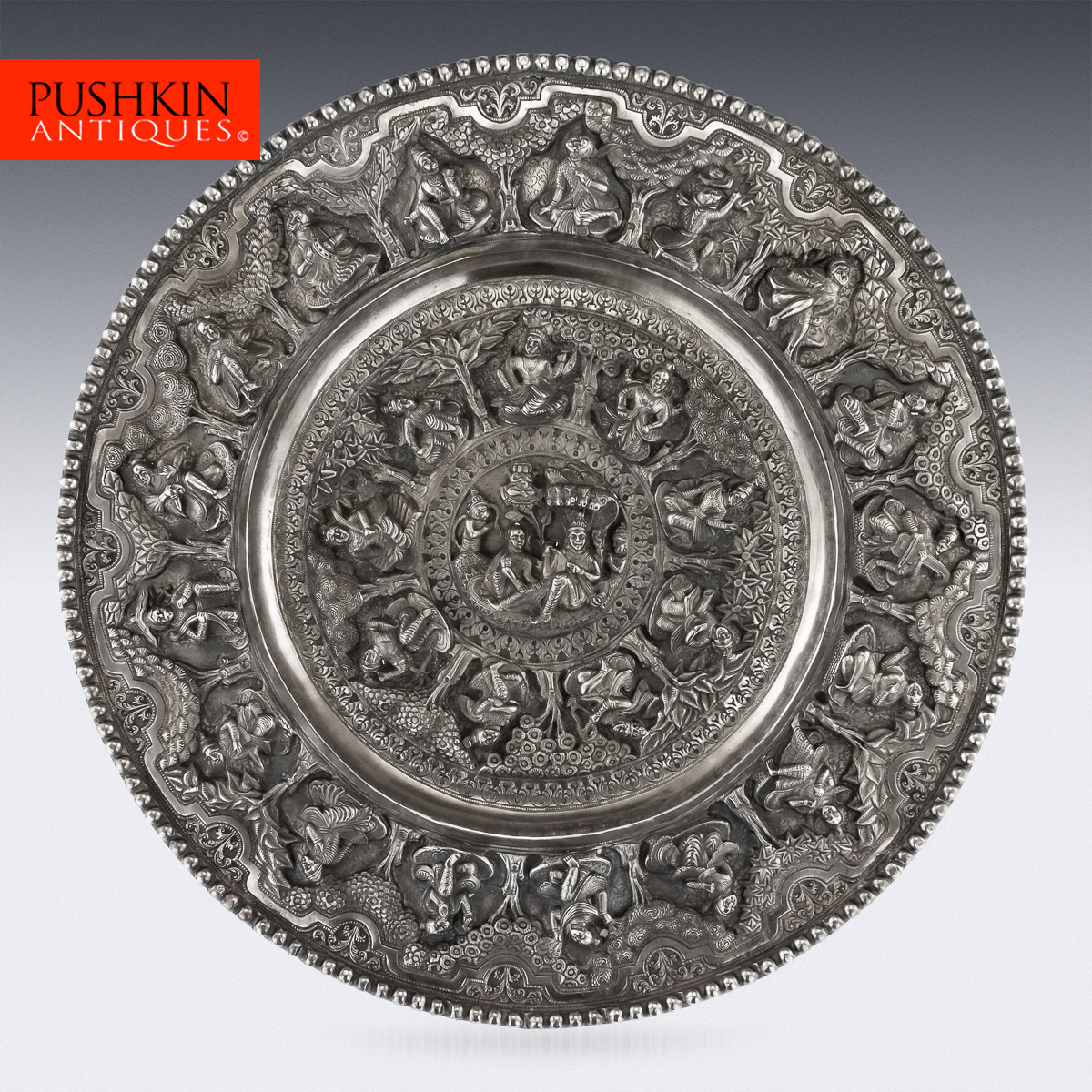
19th Century Indian silver dish, of impressive size, highly-decorative, embossed with various figures of deities, surrounded with bands of scrolling floral foliage, plain boarder and large bead boarder. The dishes distinctive design is typical to the region of Poona, located 120 miles south-east of Bombay, Occupied by the British since the 1802, it was the perfect military base, being 2000ft above sea level, making the unbearably hot Indian summers more bearable. Poona style closely resembles the silver commonly made in Madras and Burma, distinguished by having large figures in high relief commonly depicting the Avatara, adventures of Vishnu or scenes from the Ramayana. Poona is often confused with Burmese silver, but elements such as wide bands of Kutch like chasing and large beaded boarders as well as the plain bands is a sure indication.
Reference Number: A5779
Bombay's silver development is complex due to its status as a trade hub, drawing silversmiths from various Indian regions, particularly Cutch. Bombay produced Cutchi-style pieces and developed a pictorial fashion combining Cutch scrollwork with scenes of village life. The Swami style also emerged here, characterised by elephant-headed spouts and handles on tea sets, along with decorative animal motifs.
Poona, like Bombay, saw a mix of Cutchi craftsmen, complicating the identification of its silver wares. A distinct Burmese-style pattern also appears, leading to confusion with Lucknow pieces. Heerappa Boochena’s works, marked and highly valued, feature deeply embossed figural scenes and Cutch-type scrolls, alongside unique demon patterns.

19th Century Indian Silver repousse bowl, impressively massive size, crisp decoration featuring two bands of Hindu deities and avatars. Each side is applied with a cast handle realistically modelled as an elephant's head. This piece is very well made, unusually large and detailed, the style is typically from Madras.
REFERENCE NUMBER: A1706

19th Century Indian Colonial P. Orr & Sons Silver four-piece tea set, comprising of a coffee pot, teapot, sugar bowl, cream jug, each straight tapered body modelled as bamboo and is beautifully decorated with a religious central band of round pannels dipicting various Swami religious scenes, inspired from the Meenakshi Amman temple in southern India, handles modelled as bamboo and finials modelled as elephants.
Hallmarked Indian Silver (900+ standard), Madras, P. Orr & Sons, it dates to 1880's.
Reference Number: A4624
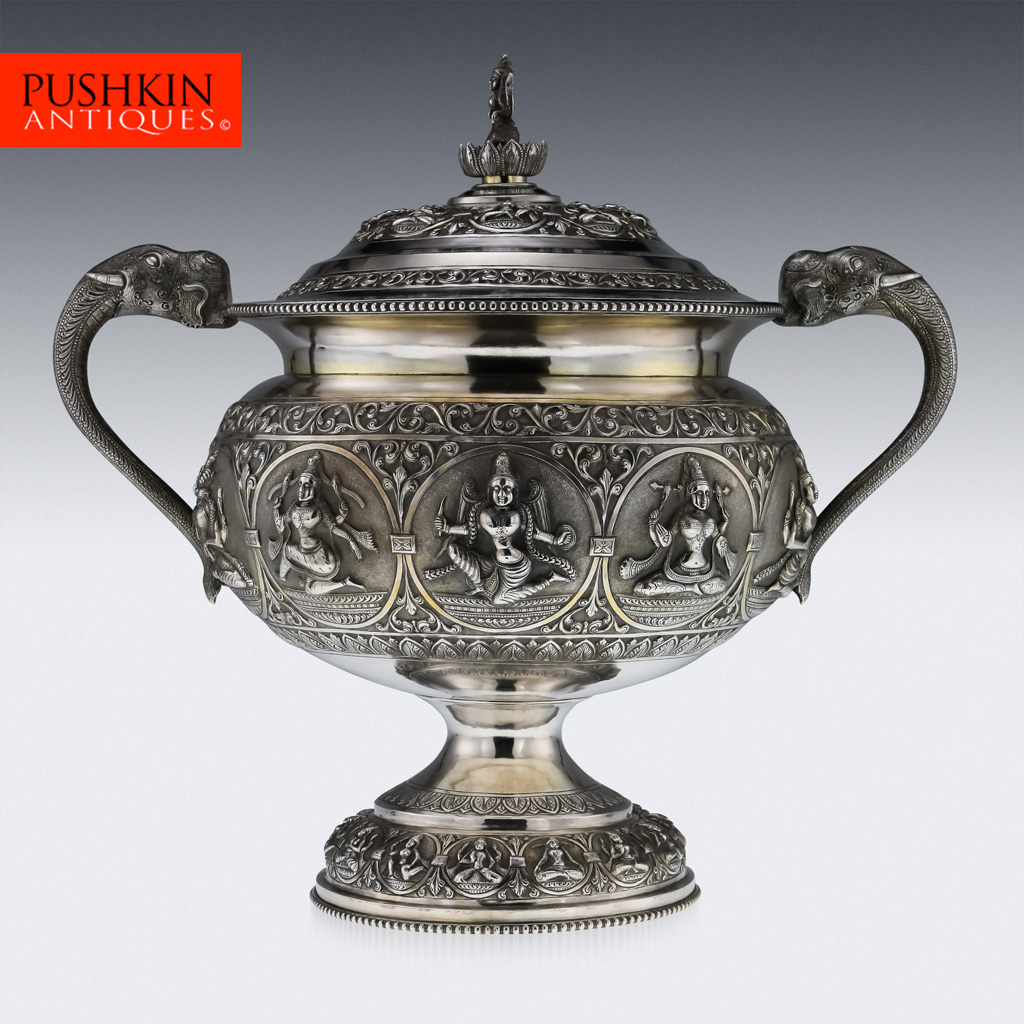
19th / early 20th Century Indian Silver repousse' bowl and cover, foliate bands surrounding a series of ten large roundels depicting dancing deities in relief (Gandharva), it stands on a circular foot featuring a similar design and is surmounted by a cover terminating with a figural finial. The bowl is parcel gilt and applied with two extremely large cast handles modelled like elephant's head.
REFERENCE NUMBER: A2496
The city of Madras is renowned for its Hindu tradition, which is reflected in its art and architecture, characterised by deities and religious figures. The silverware from this region, known as “Swami silver,” showcases this influence through decorative designs of Hindu idols (Swami is the Hindu word for idols). Swami silver pieces are created using repoussé and chasing techniques, featuring intricately detailed deities in various positions, often enclosed in circular cartouches or stylised temples, and surrounded by scrolling foliage or arranged in parades. The most notable silversmith in Madras was the Scottish clockmaker P. Orr, who established his shop in 1851 and collaborated with local artisans to specialise in Swami silver, marking his pieces with “P. Orr & Sons.” While many other workshops produced high-quality Swami silver during the latter half of the 19th century, most did not hallmark their items.
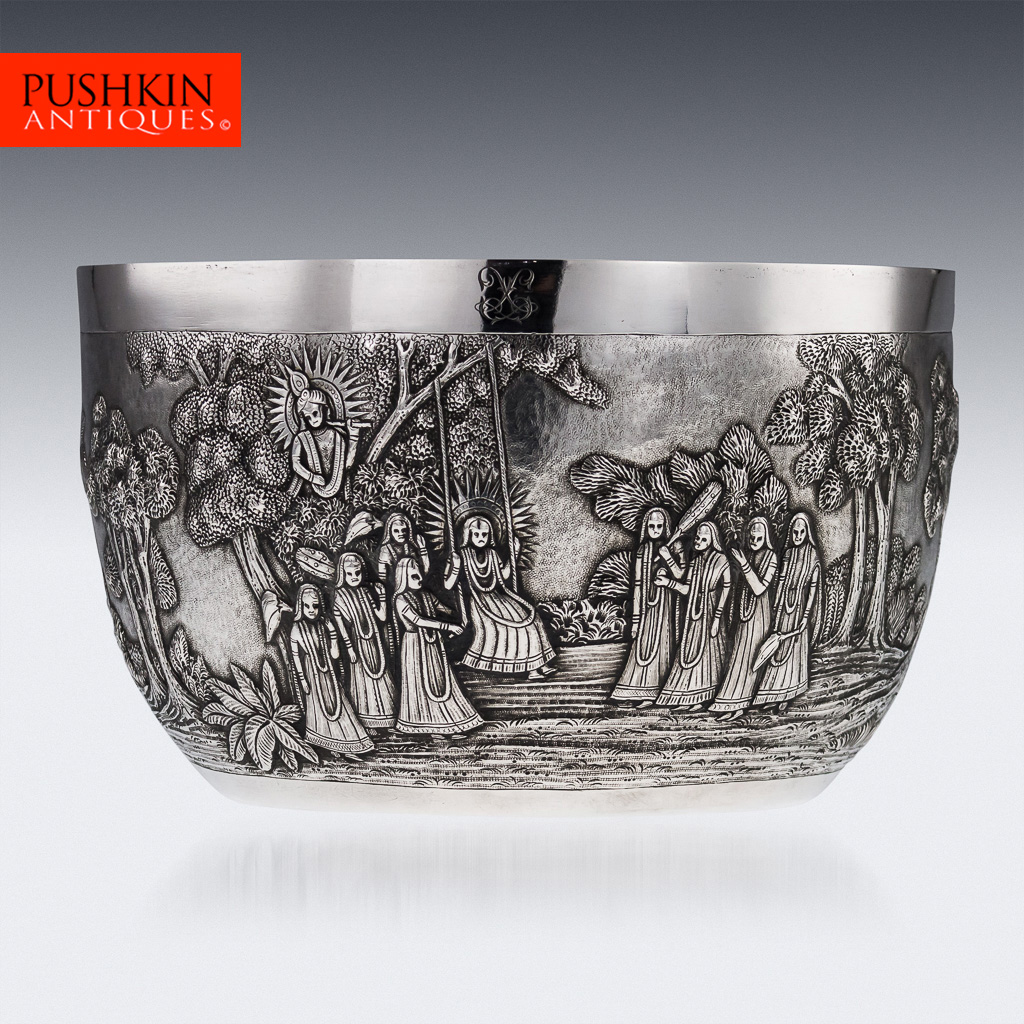
19th Century rare Indian Solid Silver bowl, finely chased with figures, Hindu deities and animals amongst trees, particularly fine and detailed repousse' work, one depicting a feast with a deity on a swing surrounded by a crowd, the other side representing a man gathering cows, the border engraved with initials. The two scenes probably refer to practices of Hindu religion and tradition.
Reference Number: A2874

20th Century Indian Silver bowl, repousse' decorated in relief with figures and villages in a landscape. The rim is engraved with an important inscription: "SIALKOT RACES 1910 HORSE STEEPLECHASE WON BY R. WYNDHAM QUINS B. AUS. M. MELODY. PRESENTED BY KHAN ABDUL GAFOOR KHAN".
The decoration depicting Indian villages and farming life is typically from The base is not marked, but acid tested shows a 900+ standard. The bowl dates before 1910.
REFERENCE NUMBER: A4120
Calcutta silver is notable for its unique design, depicting scenes of Indian everyday life with human figures engaged in farming, accompanied by animals amidst trees, hills, buildings, and cities. This style tends to be smoother and less detailed than other Indian designs, favouring calm bucolic scenes over the more adventurous and sometimes violent themes found in Cutch or Lucknow silver. Established by the British in 1690, Calcutta has the longest history of silver production in India. By the 1770s, European-owned firms were creating British-style silver. The opening of the Suez Canal and the rise of global trade led to a demand for a distinct regional style, resulting in decorative patterns for the 1883 Calcutta International Exhibition. Common motifs included village scenes of Bengali life and Bamboo patterns influenced by Chinese export silver, with notable works produced by the famous firm Dass & Dutt, which operated in Bhowanipore during the late 19th century.

20th Century Indian Silver ewer, the body is profusely and beautifully decorated with the typically Kashmiri stylized foliage known as the Islamic-inspired "shawl pattern".
The silver is not hallmarked as always the case for Kashmiri silver, acid tested shows a 800+ silver standard, it dates to the 1910-20.
REFERENCE NUMBER: A4131

19th Century Indian Silver three-piece tea set, comprising of teapot, sugar bowl and cream jug, each spherical body is profusely and beautifully decorated with the typically Kashmiri stylized foliage known as the Islamic-inspired "shawl pattern".
Hallmarked with Continental import marks "A800" (for Belgian silver, acid tested shows a 800+ standard), plus another silversmith / retailer's mark (GM with a hammer in between). The Belgian marks are in use after 1942, but the set originally dates to between 1880-1900.
REFERENCE NUMBER: A2990
Kashmir silver is easily recognisable and distinctive compared to other Indian styles. Local silversmiths, primarily of Muslim culture, adopted a unique arabesque decoration featuring stylised foliage, commonly used on tea services and other silver objects, such as rosewater sprinkles. This characteristic pattern is known as the “paisley” design.
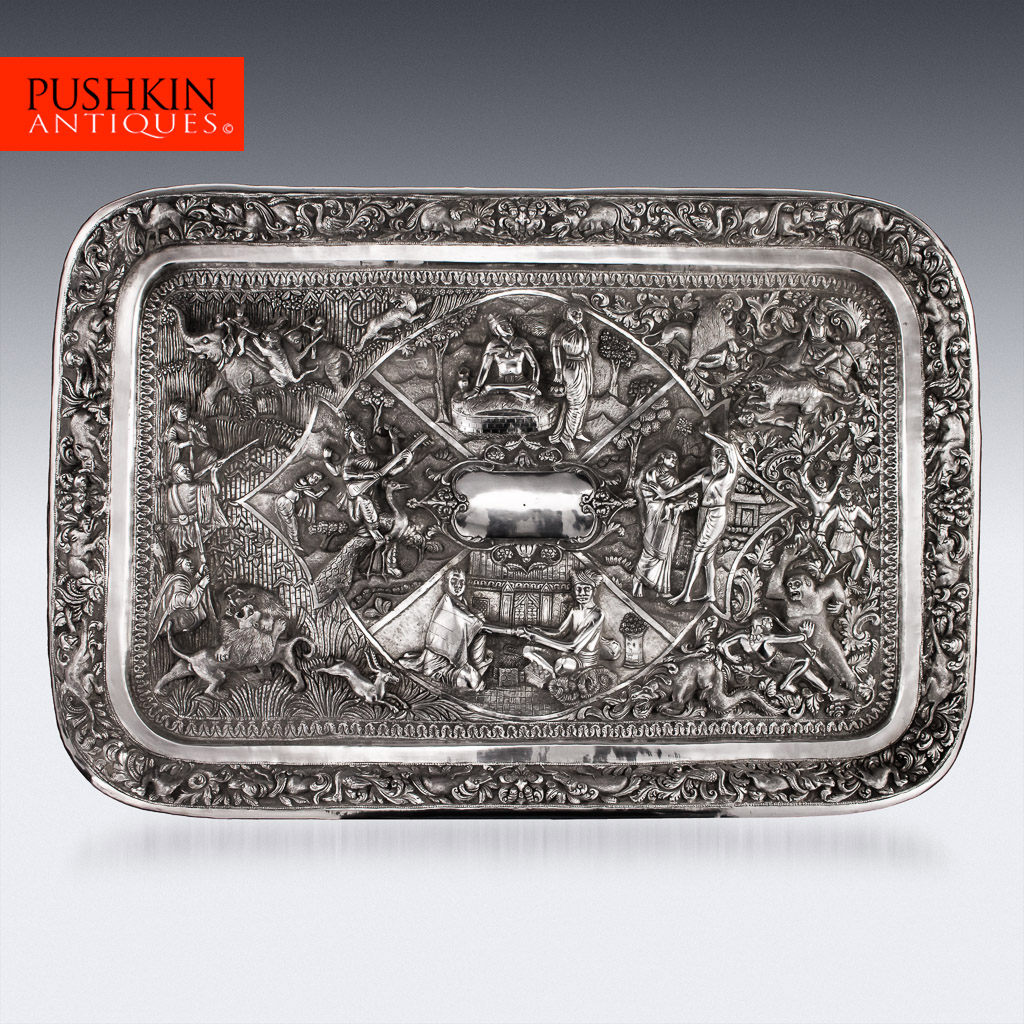
19th Century Indian / Burmese Silver charger tray, impressively large, heavy and magnificent, profusely decorated in high relief with a series of hunting scenes, with hunters riding elephants and horses amid scrolling foliage and vegetation, attacked by tigers and lions, animals fighting, a man fighting with a gorilla, the centre is embossed with four panels featuring deities and loving scenes.
The rim is Hallmarked French import silver (swan, 900+ standard).
REFERENCE NUMBER: A2799

19th Century Indian silver massive vase, profusely chased and embossed in high relief with a particularly detailed "Jungle" scenes, depicting an intricate forest populated by a variety of animals in relief, surrounded by foliate bands, removable collar in the same style.
REFERENCE NUMBER: A1982
Lucknow, in Northern India, has a rich silversmithing history that dates back to the 10th century, primarily influenced by Islamic culture. By the latter part of the 19th century, local silversmiths began adopting and blending patterns from various regions, including Cutch, Madras, Calcutta, and Kashmir, making it challenging to identify Lucknow silver. Despite this, several recurring patterns are characteristic of the style: the hunting pattern, which depicts animals and hunters on elephants and horses, the scrolling foliage typical of Cutch, and jungle patterns featuring groves of palms and diverse wildlife. Rather than signing their pieces in the Western manner with names or initials, Lucknow silversmiths engrave unique figural hallmarks—often stylised flowers or animals—on the underside of their silver items.

The image above showcases various works by Indian silversmiths from our archives, highlighting their intricate patterns and characteristic styles.
Antique 19th Century Indian Kutch hand-crafted solid silver cigar case. Of rectangular form with rounded edges, finely chased throughout with scrolling leaves and floral patterns on a finely tooled matted ground. On one side engraved plaque with initials "E C" and a stag crest. This case is particularly fine quality, but unfortunately unmarked. Tested 900+ grade silver.
Reference Number: C10380