

In periods of inflation and economic uncertainty, investors traditionally turn towards tangible assets. Gold, property and precious metals immediately come to mind, but there is another asset class that has been quietly preserving wealth, and giving its owners considerable pleasure, for generations - fine antiques and collectables.
Unlike shares on a screen, an antique is something you can live with. A Georgian silver tea service can be used and admired. A fine gold box can be held in the hand. A piece of important furniture can form part of an interior for decades before passing to another generation. This combination of financial value, scarcity, craftsmanship and personal enjoyment makes antiques an unusual form of alternative asset.
Academic research increasingly recognises this distinction. Research from the Centre for Endowment Asset Management at Cambridge Judge Business School has examined alternative assets over very long periods, including art, furniture, jewellery, wine, classic cars and other collectables.
A 2026 study examined up to 110 years of data across 13 categories of collectables and identified what the researchers describe as an “emotional yield”, the non-financial return owners receive simply from possessing and enjoying beautiful or culturally significant objects. That is an important concept. A financial investment generally has to reward its owner financially. A great antique can provide enjoyment throughout the period of ownership as well as the possibility of capital appreciation. But antiques should never be presented as guaranteed investments. They are relatively illiquid, values can fluctuate, tastes change and buying and selling costs can be considerable. Research into collectables has repeatedly highlighted these characteristics. The key, therefore, is not simply to buy antiques. It is to buy the right antiques, at the right price, from the right source.
Scarcity matters
Inflation gradually reduces the purchasing power of money. A genuinely rare antique operates rather differently because its supply cannot simply be increased. There will never be another piece of Georgian silver made in 1775. No more original Fabergé objects will be produced by the historic workshops of Imperial Russia. The surviving output of important silversmiths, designers and craftsmen is finite, and in some instances, diminishes through damage, loss or acquisition by museums and permanent collections. This scarcity is one reason collectors have historically been attracted to tangible assets. Yet age alone does not create investment quality.
An object should ideally possess several characteristics: rarity, quality, condition, provenance, an important maker or workshop, historical relevance and continuing international desirability. A mediocre antique does not automatically become a good investment simply because it is old.
Buy quality, not quantity
For someone beginning a collection, perhaps the most important principle is simple: Buy fewer, better things. It is generally preferable to own one exceptional object rather than ten ordinary examples. Look for pieces representing the best craftsmanship within their category. Study makers, periods, hallmarks and provenance. Examine the condition carefully and understand what has been restored or altered. The difference between an average object and an exceptional example can be enormous, and knowledgeable collectors will usually recognise that difference.
At Pushkin’s, we have always believed that the best purchases tend to be objects that would remain desirable even if investment considerations were removed entirely. In other words: would you still want to own it if its value did not increase tomorrow? If the answer is yes, you are already approaching collecting from a sensible perspective.
Economic downturns can create opportunity
Recessions are not automatically good for antiques. Collectables can fall in value and some areas of the market are considerably more vulnerable to changing fashions than others. However, periods of economic uncertainty can create opportunities. Estates may sell. Collectors may rationalise collections. Dealers may release stock. Objects that have remained in private hands for decades can return to the market. For the patient buyer, that can present opportunities to acquire exceptional objects that are simply unavailable during other periods. This is where knowledge becomes particularly valuable. The objective should not be to speculate on what happens to be fashionable today, but to recognise enduring quality when it becomes available.
Diversification - but with your eyes open
Collectables are sometimes discussed as a way of diversifying wealth away from conventional financial markets. There is some historical evidence supporting the diversification argument, but antiques should not be treated as a substitute for a properly diversified financial portfolio. They produce no dividend or interest. They require insurance and appropriate care. They can take time to sell and transaction costs can be substantially higher than buying or selling listed securities. Their strength lies elsewhere. They are tangible, finite assets with an established international collecting market, and their value is influenced by factors quite different from those determining the daily movement of financial markets. For the right collector, this can make fine antiques an interesting component of broader wealth diversification, particularly when the owner also derives decades of pleasure from them.
Provenance is becoming increasingly important
In today's market, what you buy is only part of the equation. Where you buy it is equally important. The internet has transformed the antiques trade and opened the market to millions of buyers. It has also made it easier for incorrectly described, heavily restored, questionable or deliberately misrepresented objects to reach inexperienced collectors. For significant purchases, buyers should establish exactly who is standing behind the description of an object. Ask for invoices. Keep provenance. Request condition reports. Understand restorations. Research the dealer. And whenever possible, buy through established specialists belonging to recognised professional trade associations.
Why we recommend LAPADA dealers
Pushkin’s is a member of LAPADA - The Association of Art & Antiques Dealers, one of the UK's established professional associations for the art and antiques trade. For a collector, membership provides an important additional layer of confidence. LAPADA members are bound by a Code of Practice requiring them to provide customers with as much clear and accurate information as reasonably practicable, including information concerning date or period, materials, maker or artist where known, provenance where known, and major restoration or later additions. When a sale is agreed, relevant descriptive details are required to be recorded on a proper invoice. There is also a LAPADA conciliation service available where a customer and member are unable to resolve a dispute.
It is important to be precise: LAPADA membership itself does not constitute a blanket guarantee of authenticity. Rather, it means that the dealer operates within a recognised professional framework and is accountable to its rules and standards. At the annual LAPADA Fair, protection goes further still: objects exhibited for sale are independently examined by specialist vetting committees to ensure they are accurately represented. For somebody spending £5,000, £50,000 or £500,000 on an object, knowing who is standing behind that object and its description matters enormously.
What should a new collector buy?
There is no single answer, and that is part of the pleasure. At Pushkin’s, our own expertise ranges from fine English and Continental silver to gold boxes, jewellery, objets de vertu, furniture, works of art and unusual collectables. Rather than trying to predict the next fashionable category, new collectors should begin with an area that genuinely interests them. Then educate yourself. Handle good examples. Visit galleries and museums. Speak to specialist dealers. Compare auction results, but remember that two apparently similar objects can differ enormously in condition, provenance, rarity and quality. Over time, your eye develops. And that knowledge is arguably one of the collector's greatest protections.
Five principles for investing in antiques
Buy quality. Exceptional examples generally deserve attention over ordinary ones.
Buy rarity. Scarcity cannot be manufactured retrospectively.
Buy what you understand. Knowledge reduces expensive mistakes.
Buy what you love. Unlike most investments, an antique can provide enjoyment every day you own it.
Buy from people you trust. Established dealers and recognised professional associations provide levels of expertise, accountability and recourse that become increasingly important as values rise.
The ultimate luxury: enjoying your investment
Perhaps the greatest argument for collecting antiques is one that cannot easily be expressed on a spreadsheet.
A share certificate cannot furnish your home. Gold bullion is unlikely to become a talking point over dinner. A bond cannot connect you physically with the craftsmanship of another century. A great antique can. It carries the fingerprints of history and represents materials, skills and craftsmanship that often cannot be replicated economically today. Will every antique increase in value? Certainly not. Can carefully selected, rare and important objects form part of a long-term approach to collecting and preserving wealth? History suggests there is a serious case for considering them.
The most successful collectors, however, understand something even more important. Buy with knowledge. Buywith patience. Buy quality. And above all, buy something you will be delighted to own.Because the greatest return from a fine antique may ultimately be that you have had the privilege of living with it.
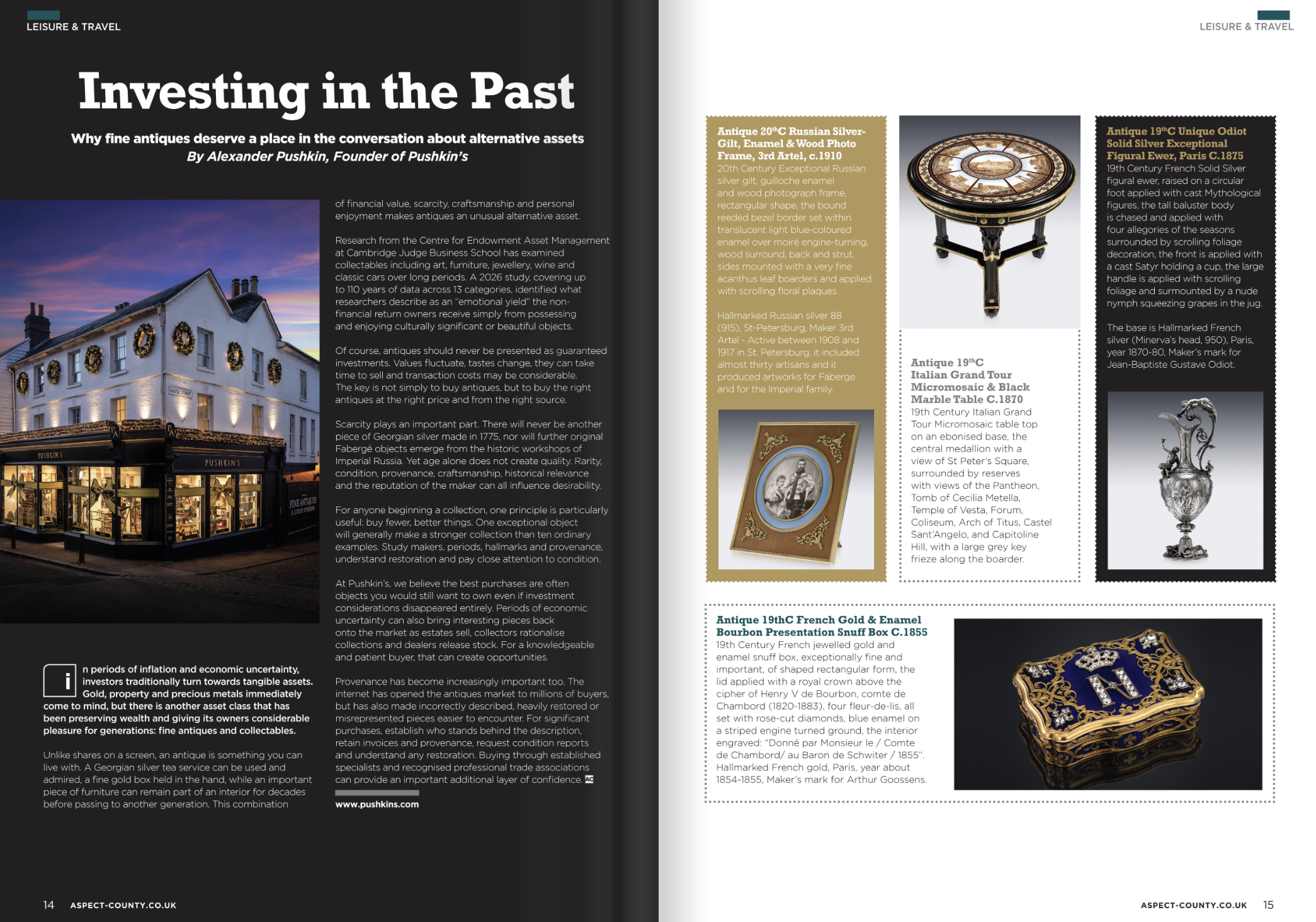
Our sincere thanks to Aspect County Magazine for featuring our work in their publication.