
From the royal courts of 18th-century Europe to the collections of modern connoisseurs, gold snuff boxes have long represented wealth, refinement and exceptional craftsmanship. These miniature works of art offer a fascinating glimpse into a world where even the smallest personal accessories could carry extraordinary significance.
The Golden Age of the Snuff Box
During the 18th century, few personal possessions conveyed sophistication and social standing quite like a finely crafted gold snuff box. What began as a practical container for powdered tobacco gradually evolved into one of the most fashionable luxury accessories of the European aristocracy. Snuff, a finely ground form of tobacco inhaled through the nose, became increasingly popular among Europe's upper classes during the 17th century. By the following century, taking snuff had developed into an elaborate social ritual, particularly within the royal courts of France, England, Prussia and Russia.
The snuff box was central to this fashionable pastime. Rather than simply carrying tobacco, wealthy individuals commissioned elaborate boxes that reflected their personal taste, wealth and position in society. A gentleman might produce an exquisitely decorated gold box during a conversation, offering its contents to fellow guests as a gesture of hospitality. The manner in which a box was handled, opened or presented could communicate subtle messages, turning an everyday habit into a sophisticated form of social interaction. For the wealthiest collectors, owning a single example was rarely sufficient. Boxes were chosen to complement different outfits, occasions and social engagements, much like fine jewellery or luxury watches today.
Miniature Masterpieces of Goldsmithing
The finest gold snuff boxes were remarkable achievements of decorative craftsmanship. Despite their modest dimensions, they often required the combined expertise of goldsmiths, engravers, enamellers, jewellers and miniature painters. Paris became a leading centre for their production during the 18th century, with workshops creating increasingly elaborate designs for the French court. Other important centres emerged in Geneva, London, Dresden and St Petersburg, each developing distinctive artistic traditions.
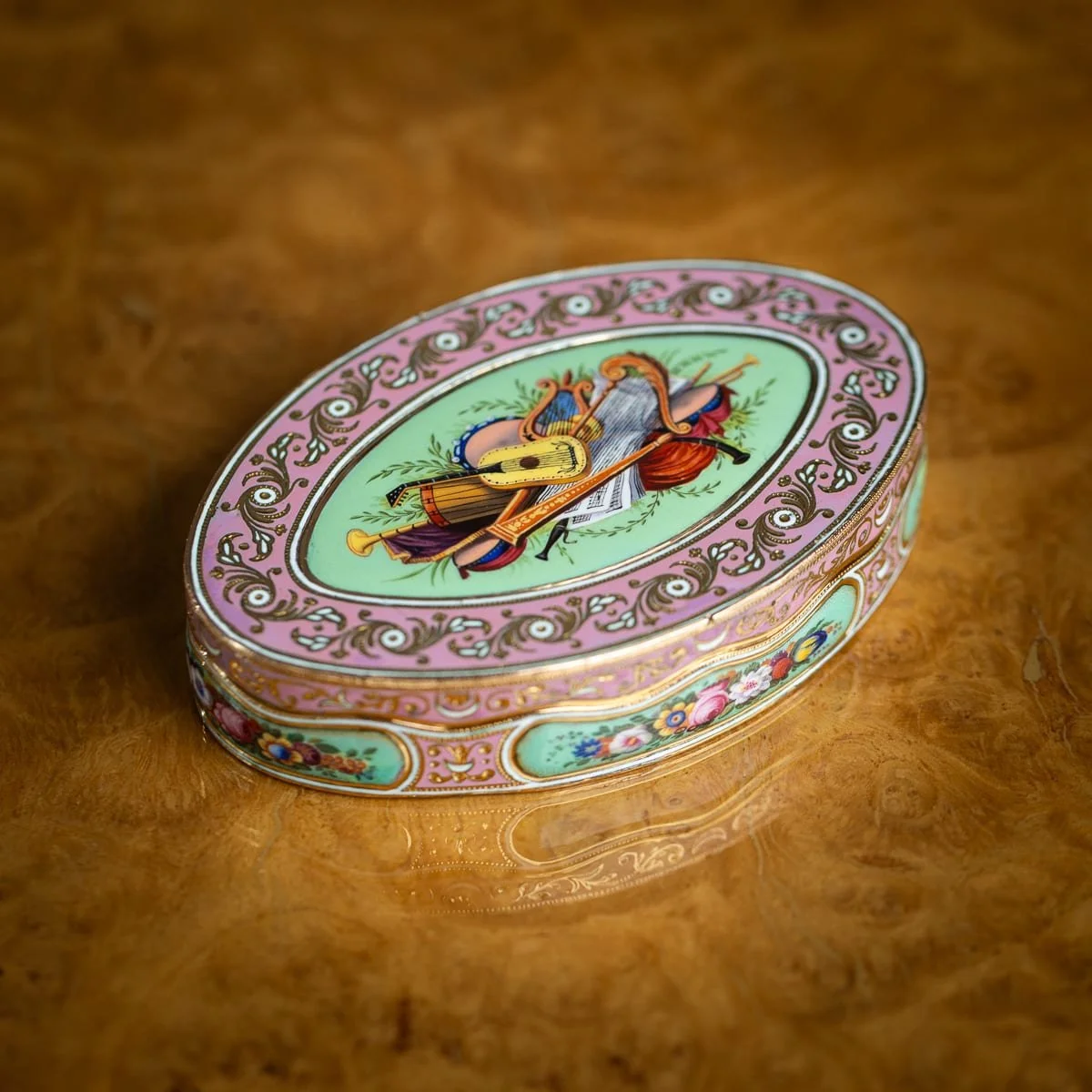
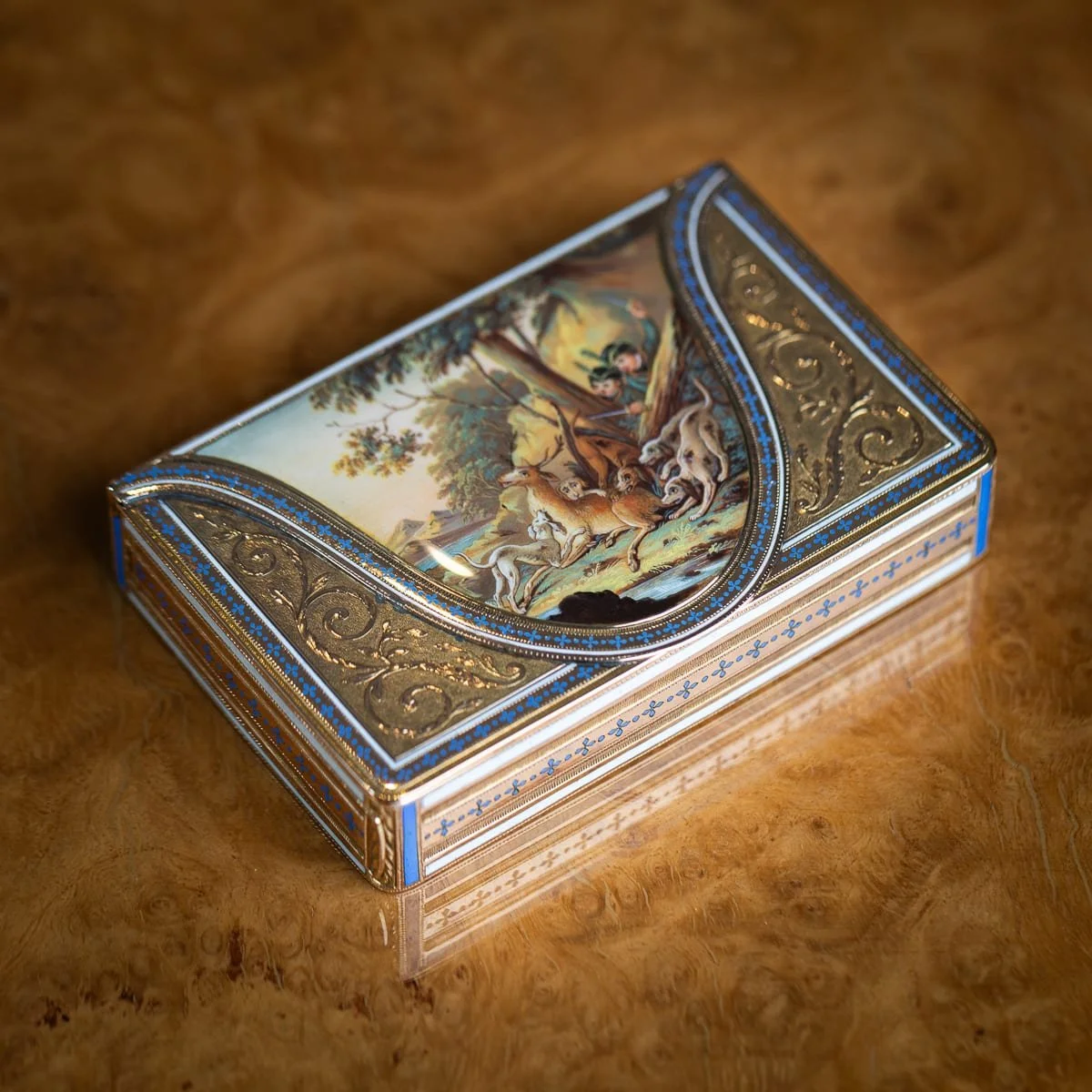
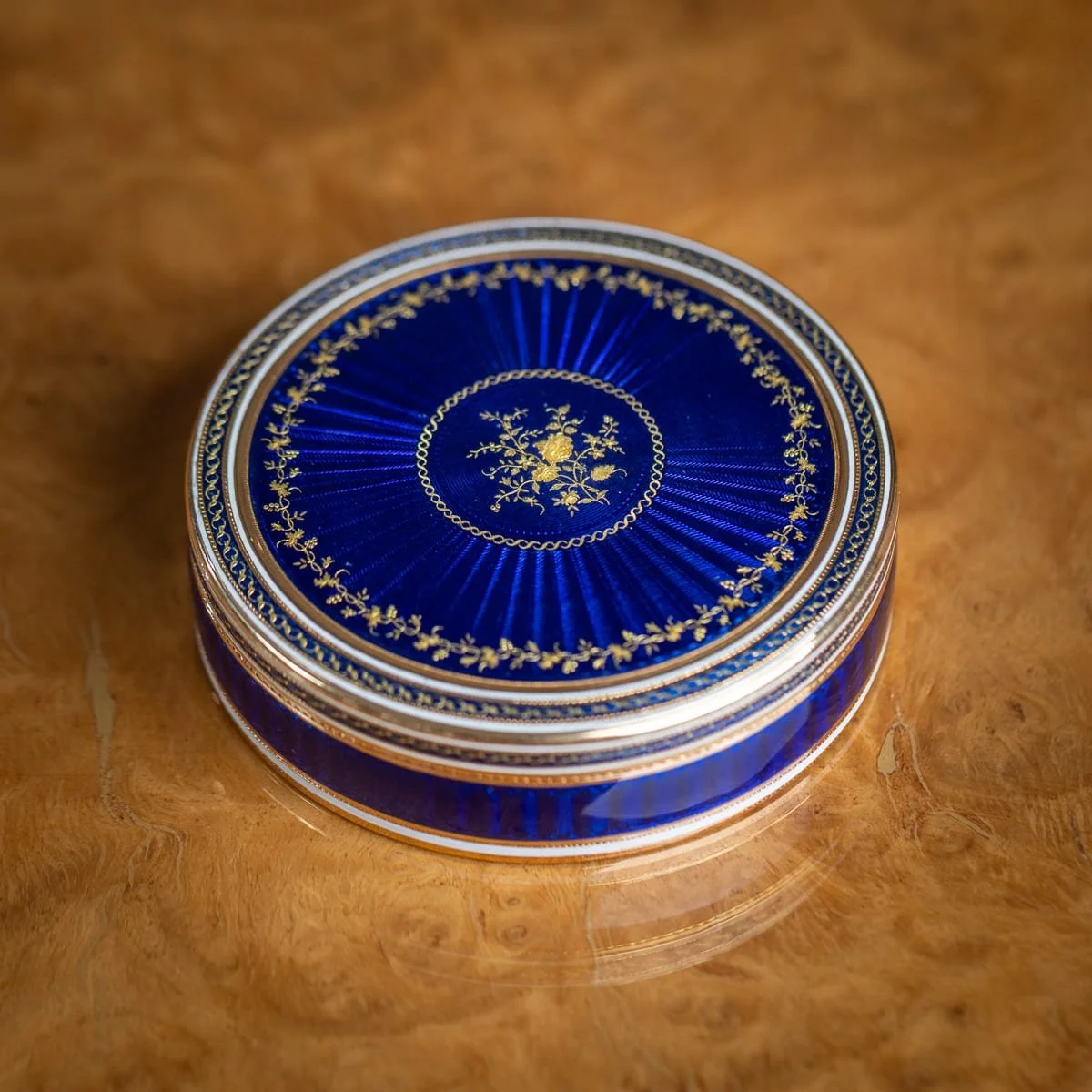
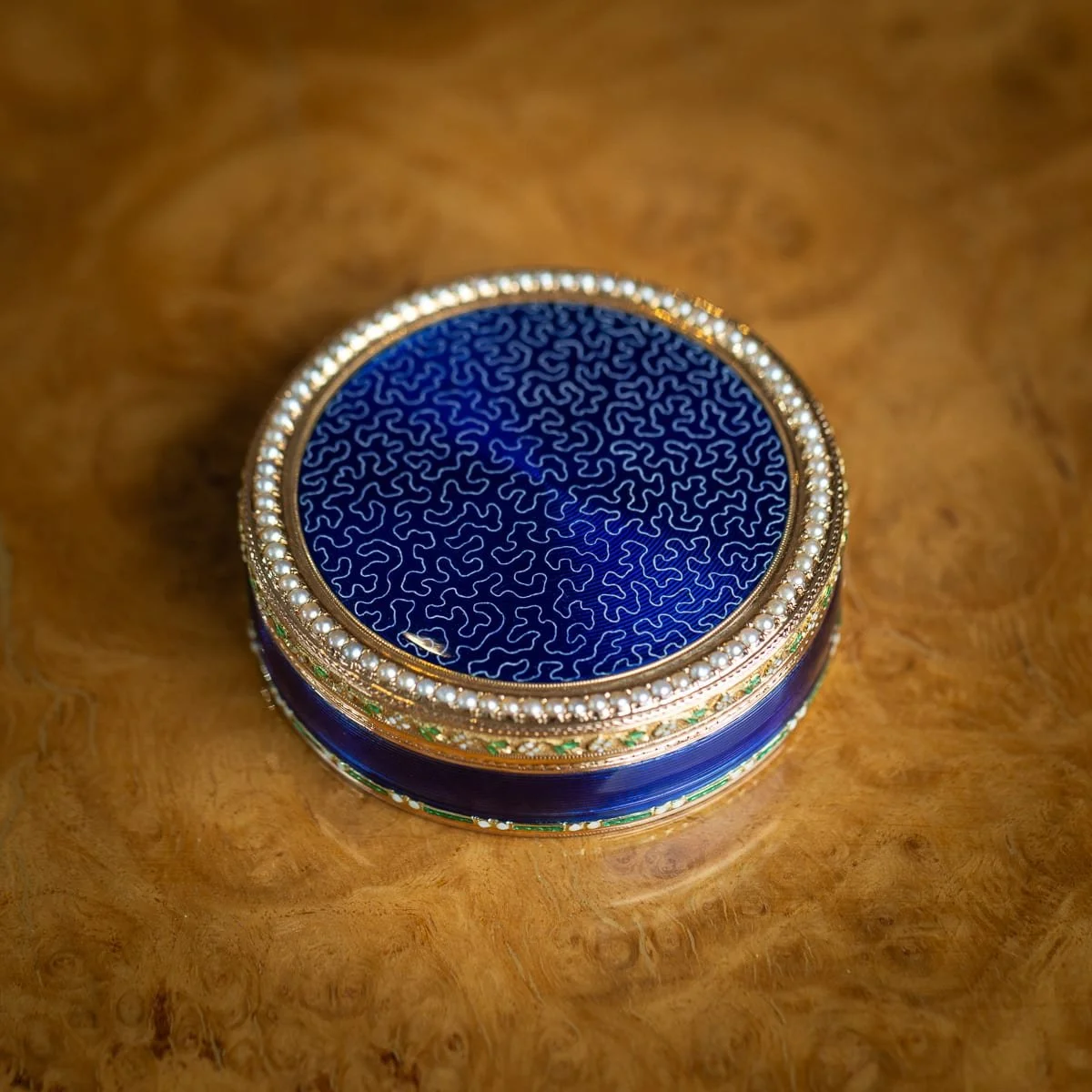
Gold was particularly prized for its beauty, durability and versatility. Craftsmen could manipulate the precious metal into delicate patterns, sculptural reliefs and intricate decorative surfaces. Among the most admired techniques was guilloché, a method of mechanically engraving precise, repeating geometric patterns into metal. These surfaces were sometimes covered with translucent enamel, allowing light to reflect through the coloured finish and reveal the intricate decoration beneath. Other boxes featured finely chased gold, floral engravings, miniature portraits, precious gemstones and elaborate enamel paintings. Some incorporated mother-of-pearl, porcelain, tortoiseshell or beautifully polished hardstones. The decoration was rarely confined to the lid. Many of the finest examples were embellished on every visible surface, including the sides, base and interior, rewarding close examination from every angle. These objects demonstrate the extraordinary attention to detail that characterised European luxury craftsmanship during the period.
A Symbol of Royal Favour and Diplomacy
Beyond their role as fashionable accessories, gold snuff boxes became important instruments of diplomacy and royal patronage. European monarchs frequently presented richly decorated boxes to ambassadors, military officers, visiting dignitaries and individuals who had provided distinguished service. Such gifts were far more personal than a simple monetary reward. Often incorporating royal portraits, monograms or precious stones, they represented a tangible expression of appreciation and favour from the sovereign.
One particularly fascinating example is associated with Catherine the Great of Russia. The empress presented a magnificent gold and diamond snuff box to the English physician Thomas Dimsdale, who successfully inoculated her and her son against smallpox in 1768. The gift commemorated an important medical achievement while demonstrating the extraordinary prestige attached to these objects. Frederick the Great of Prussia was another enthusiastic admirer of snuff boxes. His collection reportedly numbered around 300 examples, including beautifully decorated boxes incorporating chrysoprase, a green variety of chalcedony. For rulers such as Frederick, collecting these miniature treasures was both a personal pleasure and an expression of royal taste.
The Enduring Appeal of Gold Snuff Boxes
Although the social ritual of taking snuff has largely disappeared, the fascination with antique gold boxes remains. Their appeal extends far beyond the intrinsic value of the precious metal. Each example represents a remarkable concentration of artistic skill, often bringing together several decorative techniques within an object small enough to fit in the palm of a hand. The Victoria and Albert Museum in London holds the celebrated Rosalinde and Arthur Gilbert Collection, which includes more than 200 gold boxes. The collection demonstrates the extraordinary diversity of materials, techniques and styles employed by European craftsmen.
The historical importance of these objects was brought into focus following a dramatic robbery at the Musée Cognacq-Jay in Paris in November 2024, when seven historic snuff boxes were stolen. Among them were three pieces on loan from the Gilbert Collection. Two were subsequently recovered and returned to public display at the V&A following conservation. Their recovery highlights the importance of preserving these rare objects, not simply as valuable antiques but as irreplaceable records of European craftsmanship and history.
Collecting Antique Gold Snuff Boxes Today
For modern collectors, gold snuff boxes occupy a distinctive position within the world of fine antiques. Their compact size makes them particularly attractive to those who appreciate exceptional craftsmanship without requiring substantial display space. A carefully selected collection can encompass an extraordinary range of artistic periods, techniques and European makers.
Several characteristics contribute to the desirability of an antique gold box. Craftsmanship and quality are fundamental. Finely executed engraving, intricate enamelwork, elaborate chasing and well-balanced proportions can distinguish an exceptional example from a more ordinary piece. Age and origin also play an important role. Eighteenth-century French gold boxes are particularly admired, although outstanding examples were produced throughout Europe. Condition and originality are equally significant. Original hinges, secure closures, well-preserved enamel and minimal restoration are important considerations when assessing a box. Provenance can add another dimension of interest. Examples with documented connections to royalty, prominent historical figures or distinguished collections may command considerable attention. Finally, rarity and artistic character often determine the appeal of an individual piece. Unusual forms, exceptional miniature paintings, intricate hardstone decoration or distinctive goldsmiths' marks can make a box especially desirable.
For serious collectors, the attraction lies in finding objects that combine beauty, authenticity and historical significance.