

Sebastian Crespell II's Masterpiece Samovar
There is a particular hush that falls over a room when a piece of genuinely old, genuinely heavy silver is set down on the table. It is not reverence, but more a recognition that the object has outlived everyone who first admired it, and intends to outlive the rest of us too. Such is the case with a remarkable solid silver hot water kettle, also known as a samovar, hallmarked London, 1837, from the workshop of Sebastian Crespell II.
To understand the kettle, one must first understand the hand that made it. The Crespell name carries a quiet authority in the history of English silver. Sebastian and James Crespell; brothers of Huguenot descent, were among the chief suppliers of silverware to the Royal Goldsmith Thomas Heming in the late 18th century, who in turn furnished the Jewel House. Sebastian Crespell II, carrying that inheritance into the early 19th century, is associated chiefly with well made domestic silver pieces intended not for display cabinets but for the breakfast and tea tables of upper class households. That distinction matters. This was silver built to be used: to be lifted, filled, poured from, polished, and used again the next morning. Surviving pieces attributed to the Crespells are typically utilitarian Georgian forms; plates, dishes, the quiet apparatus of daily service, which makes the samovar, with its ambitious chasing and narrative decoration, an unusually grand statement from a workshop more often associated with restraint.
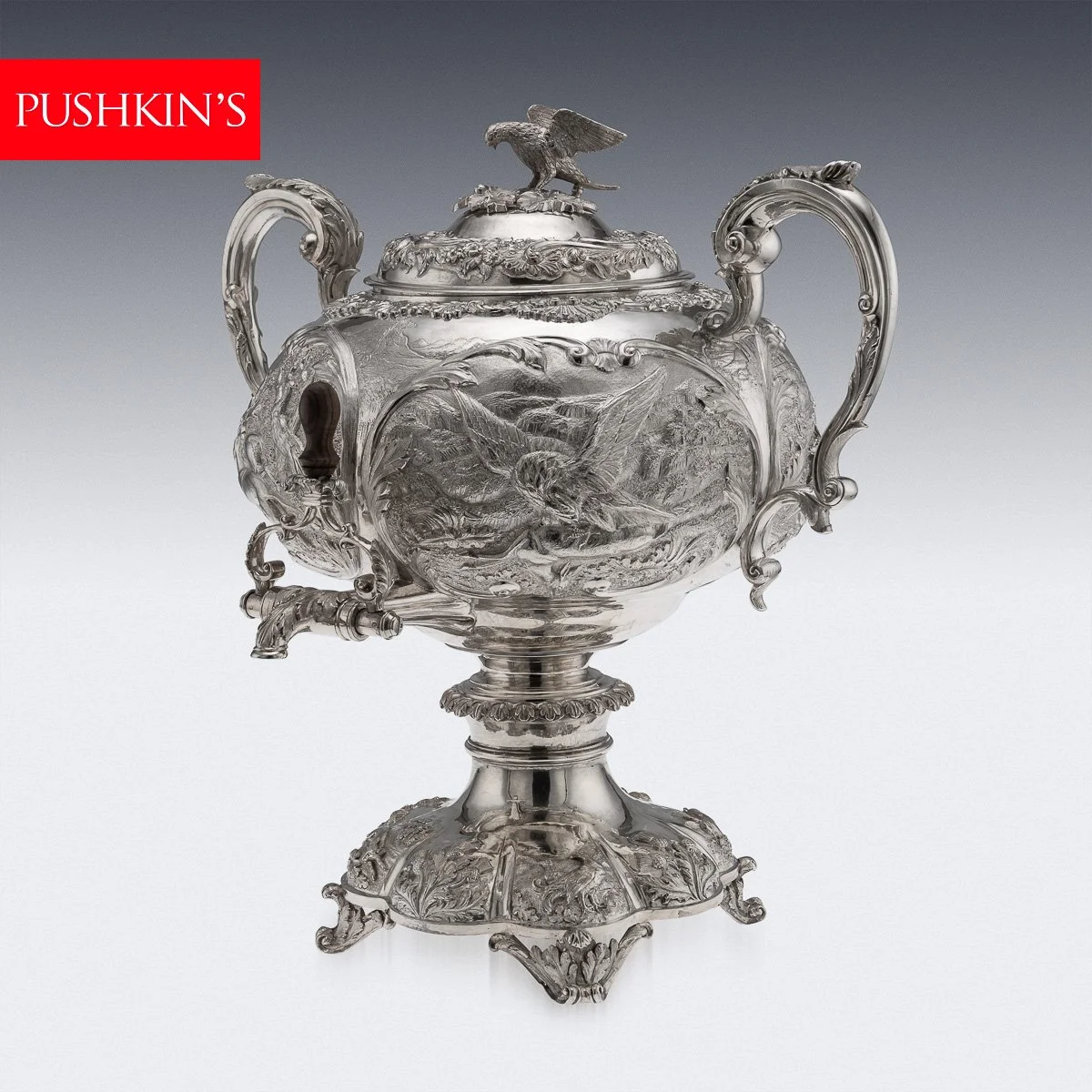
Antique 19th Century English William IV solid silver samovar / hot water kettle. This samovar is heavily worked and highly decorative. The compressed bell shaped lid has a floral and C-scroll border and is mounted with a large cast eagle finial with partially spread wings. The lid sits firmly over a spherical body divided into elaborately chased cartouches depicting hunting scenes, including stags, hounds and birds set among dense foliage.
On either side are acanthus capped double scroll handles, cast and symmetrical in form. The spigot is set centrally to the front, with an ornate mount and a wooden handle. The body rises from a knopped socle, which leads to a lobed base decorated in a similar manner to the main body, with further chased naturalistic panels. The samovar stands on four acanthus scrolled feet. The interior retains its original hot iron holder.
Hallmarked English solid silver (925 standard), London, year 1837 (B), Maker's mark sc (Sebastian Crespell II).
Reference Number: A00124
The kettle is a substantial item, both in grandeur and scale. The lid sits firmly over a spherical body divided into elaborately chased cartouches depicting hunting scenes: stags, hounds, and birds set among dense foliage. On either side are acanthus capped double scroll handles, cast and symmetrical in form. The spigot is set centrally to the front, with an ornate mount and a turned wooden handle; the wood a practical touch, keeping the user's hand from the hot metal. The body rises from a knopped socle, which leads to a lobed base decorated in a similar manner to the main body, with further chased naturalistic panels. The whole stands on four acanthus scrolled feet.
Crucially, the interior retains its original hot pig iron holder, the heated core that kept the contents near boiling for the length of a leisurely meal. It is the detail that separates a working samovar from a decorative one, and the detail that, two centuries on, most pieces have lost.
What lifts this piece above mere ornament is its iconography. The cartouches are not abstract flourishes but narrative panels depicting hunting scenes; stags, hounds, and birds set among dense foliage.
The hunting motif was the defining decorative language of the 1830s. The decade's aristocracy lived by the hunt; the chase was both sport and social theatre, and silver commissioned for great houses wore that world on its surface. Stags at bay, hounds in full cry, game birds rising from cover, these were not quaint country scenes but declarations of belonging, of land and leisure and the mounted life. Translated into chased silver, they turned a domestic object into a coat of arms rendered in metal.
The appeal has not faded. Hunting scene silver remains among the most sought after categories on the modern antiques market, collectors and decorators drawn to the same combination of narrative and craftsmanship that pleased the original owners. A kettle that tells a story across its body has never gone out of fashion.