

From Studio Tool to Sculptural Object: The History of Lay Figures
Lay figure mannequins were once practical studio tools. Today, the best surviving examples read just as clearly as sculpture.
Used by artists, sculptors, tailors and academies, these articulated wooden figures helped with the study of anatomy, proportion, drapery and movement. Before photography made it easy to capture a pose, a lay figure offered something reusable and adjustable: a body that could be turned, tilted and posed as needed.
Their history stretches back several centuries. The earliest notable examples appeared in South Germany in the early 16th century, where finely carved articulated figures were made with remarkable mechanical precision. Many of those early models were less workshop tools than collector's objects, created for Kunstkammer collections during the Renaissance fascination with the human form.
By the 18th and 19th Centuries, lay figures had become more firmly established in working studios. They were often made in woods such as pine, linden or walnut, and their forms grew more neutral and practical. In France around 1850, they reached a high point of popularity, when a fine mannequin articulé could count among an artist's valued possessions.
That working history explains their rarity now. Most were used hard, handled often and worn over time. Life size examples are especially scarce, both because fewer were made and because large studio models were more vulnerable to damage, repair and loss.
Two current examples show the category at its strongest. The earlier, a French life size lay figure dating to around 1860, is notable for its well defined anatomical carving and unusual fully articulated index fingers, a rare feature that points to exceptional workmanship. Standing 165 cm high, it retains its original features, with only minor wear to the little fingers, and has the surface character expected of a piece that spent its life in a working studio.
The later example, a continental life size lay figure dating to around 1910, shows the form continuing into the early 20th Century with equal confidence. At 160 cm high, it has a sensitively modelled face, natural proportions and fully articulated joints at the shoulders, elbows, wrists, hips, knees and ankles. Made from a medium-hard timber, possibly pitch pine, it has acquired a warm honey coloured patina through age and use.
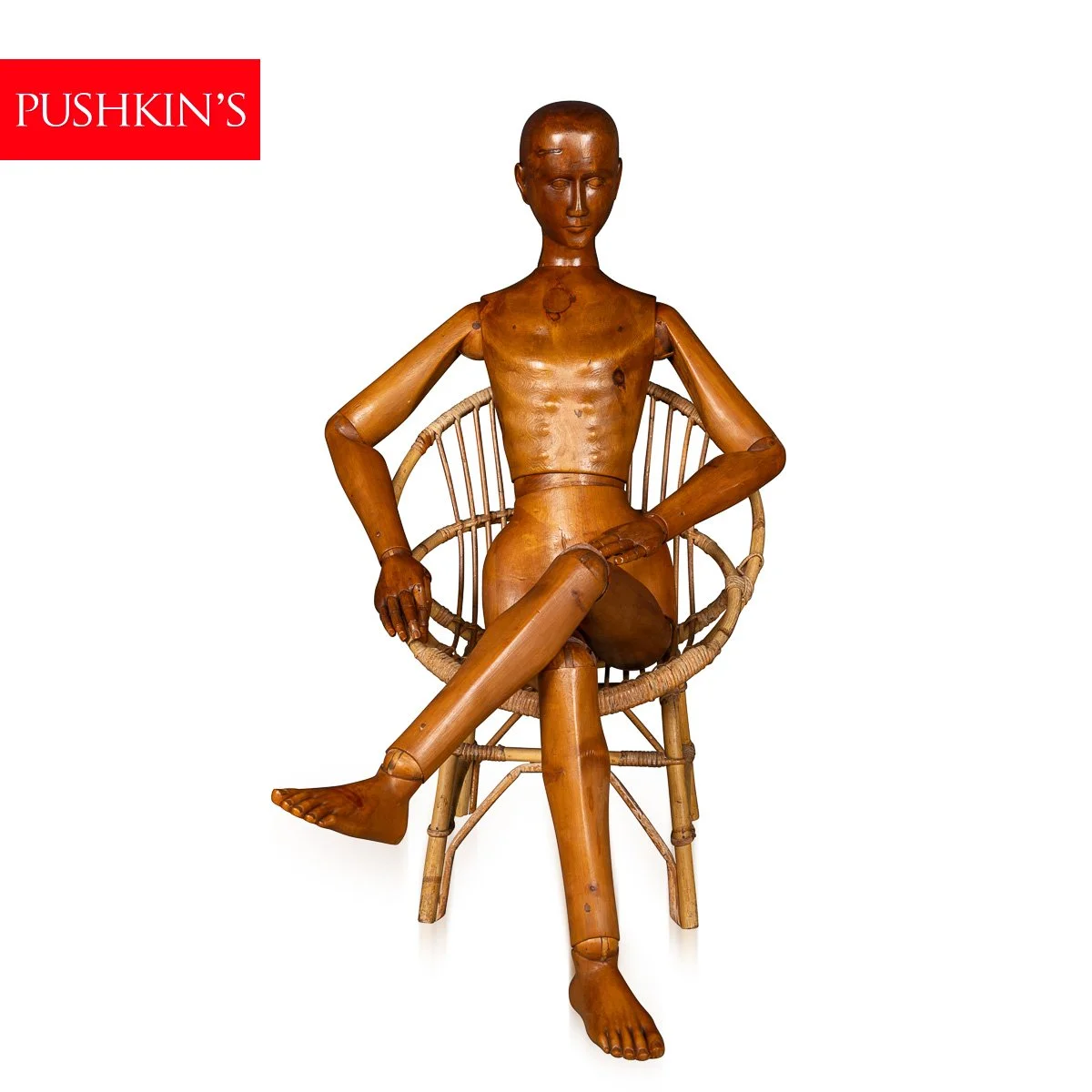
A rare and impressive life-sized carved wooden artist's mannequin dating to the early twentieth century, of continental origin and executed with remarkable attention to anatomical form and articulation. Carved with a sensitively modelled face and naturalistic proportions, the figure possesses a strong sculptural presence and considerable decorative appeal.
The mannequin is constructed from a medium-hard timber, possibly pitch pine, displaying a warm honey-coloured patina acquired through age and use. The body is fully articulated with movable joints at the shoulders, elbows, wrists, hips, knees, and ankles, allowing the figure to be posed in a wide variety of positions. Such mannequins were traditionally employed by artists, sculptors, tailors, and academies as aids for studying human anatomy, proportion, drapery, and movement.
Unlike the smaller desk models more commonly encountered, life-sized examples are considerably rarer and were often used in professional studios and teaching environments. The carefully carved facial features and articulated hands and feet elevate the piece beyond a purely functional studio tool, giving it the quality of a sculptural object in its own right.
Today, early life-sized mannequins are highly sought after by collectors of decorative arts and interior designers alike, valued for their distinctive character, sculptural form, and ability to create a dramatic focal point within both traditional and contemporary interiors.
Reference Number: B12324

A rare and impressive life-size wooden artist’s lay figure, French, dating to the second half of the 19th century. Beautifully carved with well-defined anatomical form, the figure features articulated limbs and notably detailed, fully articulated index fingers (an unusual and highly desirable feature).
Reference Number: B12023
What makes such figures compelling is that they were built for use but survive as art. Their joints, wear and carved features still speak of the studio, but their scale and presence now give them a second life as sculptural objects. In the best examples, utility and beauty are inseparable.
These two mannequins are not simply decorative curiosities. They belong to a long tradition of artistic practice, when the study of the body depended as much on carved wood and mechanical ingenuity as on direct observation. Seen now, they offer both a record of that tradition and a striking physical presence of their own.