

The Art of Meiji Silver: Shibayama, Enamel and Japanese Master Craftsmanship
The Japanese Meiji period (1868–1912) was one of the most important eras in the history of Japanese decorative art. Following the Meiji Restoration, Japan modernised rapidly and expanded its commercial and cultural relationships with Europe and America. International exhibitions, foreign trade and the growth of ports such as Yokohama created a new market for Japanese luxury goods.
This transformation had a major effect on traditional craftsmen. Metalworkers who had previously produced swords, fittings and objects for the samurai class increasingly turned their skills towards decorative works for domestic and international collectors. Silver bowls, vases, tea services, incense burners, animal models and presentation pieces became important expressions of this new market.
The finest Meiji silver is distinguished by exceptional technical quality. Craftsmen used repoussé, chasing, engraving, casting, applied high relief decoration and intricate surface texturing, often combining these techniques on a single object. Some vessels were double walled, allowing extremely deep relief decoration while maintaining a smooth interior. Naturalistic subjects were especially popular. Dragons, chrysanthemums, peonies, irises, birds and insects appear repeatedly, often rendered with remarkable sculptural detail. Rather than simply decorating a flat silver surface, Meiji craftsmen frequently transformed the vessel itself into a three dimensional work of art.
Japanese design and the export market
Many Meiji silver objects combine Japanese craftsmanship with forms created specifically for Western buyers. Tea and coffee services are a good example. The basic shapes may follow European conventions, while the decoration remains distinctly Japanese. Floral and natural motifs were not simply ornamental. Irises, chrysanthemums and peonies carried seasonal, literary and symbolic associations within Japanese culture. This gave many export pieces a deeper cultural significance than was immediately apparent to foreign buyers.
The Yokohama export trade played a central role in this development. Japanese workshops worked closely with retailers and merchants who supplied expatriates, travellers and overseas collectors. Among the best known names was Konoike, a Yokohama company associated with high quality Japanese silverware. The Metropolitan Museum of Art holds an important silver Dragon Bowl of 1895 bearing the names of both metalworker Kurokawa Eishō and the Konoike Company, demonstrating the collaborative relationship between individual craftsmen and commercial firms. Another important retailer was Arthur & Bond, an English company active in Yokohama and later Kobe and London. The firm sold Japanese silver and decorative objects to an international clientele. Examples in the Pushkin’s archive include elaborate sterling silver tea and coffee services decorated with irises and other Japanese motifs. Collectors also frequently encounter the mark 純銀 - Jungin or Jun-gin, meaning “pure silver”. Meiji and early 20thCentury pieces bearing this mark are often of very high silver purity, commonly around 950 or above.
Shibayama
Alongside silver, one of the most distinctive decorative techniques associated with the Meiji period is Shibayama. Shibayama is not a type of silverwork. It is a sophisticated form of relief inlay, usually involving individually carved pieces of mother of pearl, shell, coral, ivory, horn, wood and other materials set into lacquer, wood or occasionally metal. The technique originated before the Meiji period and is traditionally associated with Ōnoki Senzō, an 18th Century craftsman who adopted the name Shibayama. It was during the Meiji era, however, that Shibayama became particularly popular with European and American collectors. Unlike flat marquetry, Shibayama decoration often projects above the surface. Flowers, birds, insects, figures and branches can therefore appear almost sculptural. Iridescent shell might be used for feathers or petals, while coral, stained ivory and other materials provide additional colour and texture. Gold lacquer techniques such as maki-e, kinji and nashiji were frequently used alongside the inlay. On particularly ambitious objects, Shibayama could also be combined with silver, enamel and filigree. This combination of materials became one of the most spectacular forms of Meiji decorative art.

Our Japanese archive contains several examples showing how silver, lacquer, enamel and Shibayama could be combined. An archived silver mounted Shibayama and enamel dish, circa 1890, reference A6387, features gold lacquer panels inlaid with mother of pearl and coral depicting birds, peonies, wisteria and flowering branches. The panels are incorporated into pierced silver filigree and enamel decoration, while the reverse uses nashiji lacquer.
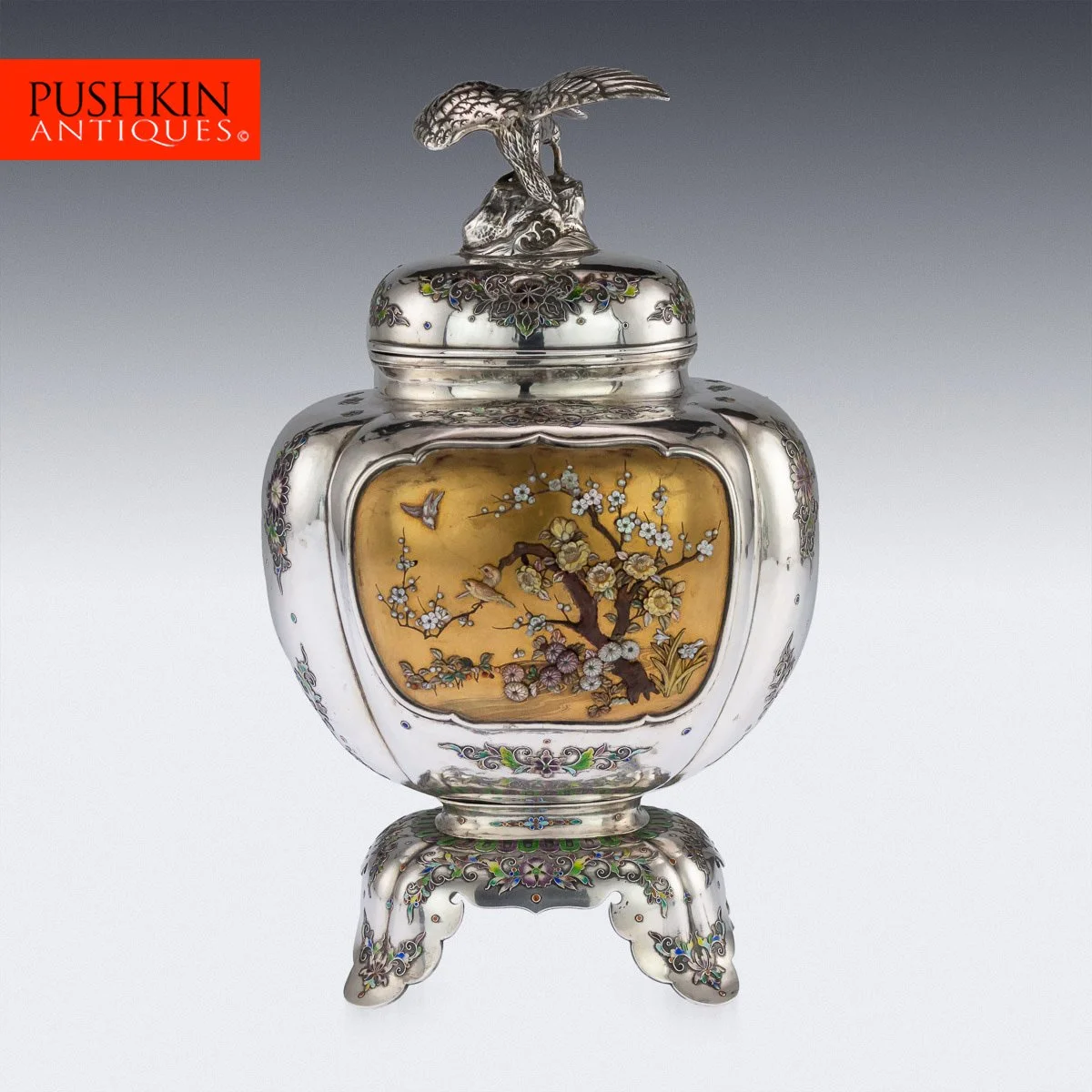
Another example is a silver, enamel and Shibayama kōro, or incense burner, reference A4632. Its gold lacquer panels are decorated with coloured mother of pearl, including a bird on a plum branch and a hanging flower basket. Silver filigree and enamel surround the panels, while an eagle forms the finial. These objects demonstrate the collaborative nature of high quality Meiji decorative art. A single work could involve the skills of silversmiths, lacquer artists, inlay specialists and enamelers.
By contrast, our archived massive silver dragon bowl, reference A4651, shows what could be achieved using silver alone. The double walled bowl is decorated with a water dragon chased, embossed and applied in extremely high relief. The distinction is useful: in sculptural Meiji silver, the metal itself becomes the principal decorative medium; in Shibayama objects, silver often forms an elaborate framework around lacquer and multi material inlay.
A strong current example of late Meiji craftsmanship is the Japanese Meiji period solid silver and enamel bowl, circa 1900, reference A00125 The decoration combines sculptural silver with coloured enamel. Large peonies are accompanied by chrysanthemums, irises, birds and insects. Enamel is used selectively in tones including crimson, pink, amber, ochre, green, ivory and violet grey.

