


Chinese Silver
“Chinese Export Silver” refers to silverware produced in China from 1780 to the 1940’s. The name is somewhat misleading, since it is not silver that was produced exclusively for the West. All silver produced in China during this period bears the name, yet it is impossible to determine which items were specifically for the West.
This wide and complex silver-making period is best divided into four major manufacturing periods: “The Formative China Trade Period” (1685-1757), “The Early China Trade Period” (1757-1842), “The Late China Trade Period” (1842-1895) and “The Post China Trade & Republic Period” (1895-1940).

19th Century Chinese Export silver filigree and enamel table mirror, very large and exceptionally fine, resting on four fish-shaped feet, applied with a blue and green enamelled filigree frame, intricately crafted creating flowers and leaves, the back and the side of the mirror is also finely decorated with enamelled filigree-work. Hallmarked with Chinese marks (900+ silver standard), year about 1870-90, Maker's mark for Da Xing.
Genuinely antique Chinese enamelled filigree pieces are exceptionally rare, most of them are now in museums or important private collections. The mirror here presented appears to be exceptional for size, rarity and quality, probably produced for a wealthy Chinese clientele and not for export.
Reference Number: A3413

19th Century Chinese Export Wang Hing Silver dragon centerpiece bowl, large size and exceptional quality, oval form, the double walled body is profusely chased in relief with dragons chasing the flaming pearl amongst clouds and flowers, the foot embellished with bamboo leaves and flowers, each side is applied with a intricately modelled dragon handle, outstanding quality. Hallmarked Chinese silver (90 for 900+ standard), Mark "WH" for Wang Hing.
Reference Number: A2789

Early-18th Century Chinese Qing Dynasty silver-gilt pair of tea cups and saucers, repousse and fine chased work, cast cups dipicting people of nobility surrounded by blossom trees and pogodas on finelly tooled ground, mounted with unusually shaped cast scroll handles. The saucers beautifully hand engraved and each applied with four convext sections dipicting birds amongst blooming flowers, such recuring scenes were favourite of Chinese court and painters of the Ming Dynasty and would continue to be used in later Chinese works of Art.
REFERENCE NUMBER: A5284
During the formative and early China trade periods, from early 18th century to the Treaty of Nanking (1842), a significant amount of Chinese silver was produced by Canton-based workshops. These pieces were often made in the neo-classical American and British Georgian styles and are distinguished by exceptionally heavy weight and high quality. This phenomenon rose out of the dramatic reduction of silver mining in South America, which in turn created a scarcity of silver in Britain and America. The silver workshops, in the main, remained anonymous to Westerners but the merchant shops they produced for have become well-known. Sun Shing and Lin Chong and others with undocumented full names, used to mark their silver with pseudo English marks (the most peculiar case is probably the maker “WE WE WC”, imitating the London hallmark of William Eley, William Fearn and William Chawner). It is not known quite why the “pseudo-hallmark” phenomenon happened; there are several conjectured reasons.
During the second half of 19th century the centres manufacturing silver wares multiplied (Shanghai, Jiujang, Tienstin, Beijing and Hong Kong above all) as a direct result of the Treaty of Nakning and the granting of treaty ports. Chinese silver came more and more into fashion as Chinese society in these cities gradually became Westernised and middle class. The fashion for the “oriental” in America and Europe made this silver popular and Western retail silversmiths regularly sold it. The production ranged from everyday items such as tea sets, jugs, mugs, bowls and boxes to exceptional and impressive trophies and presentation pieces, becoming more elaborate and intricately decorated, many with traditional Chinese motifs applied onto Western forms.
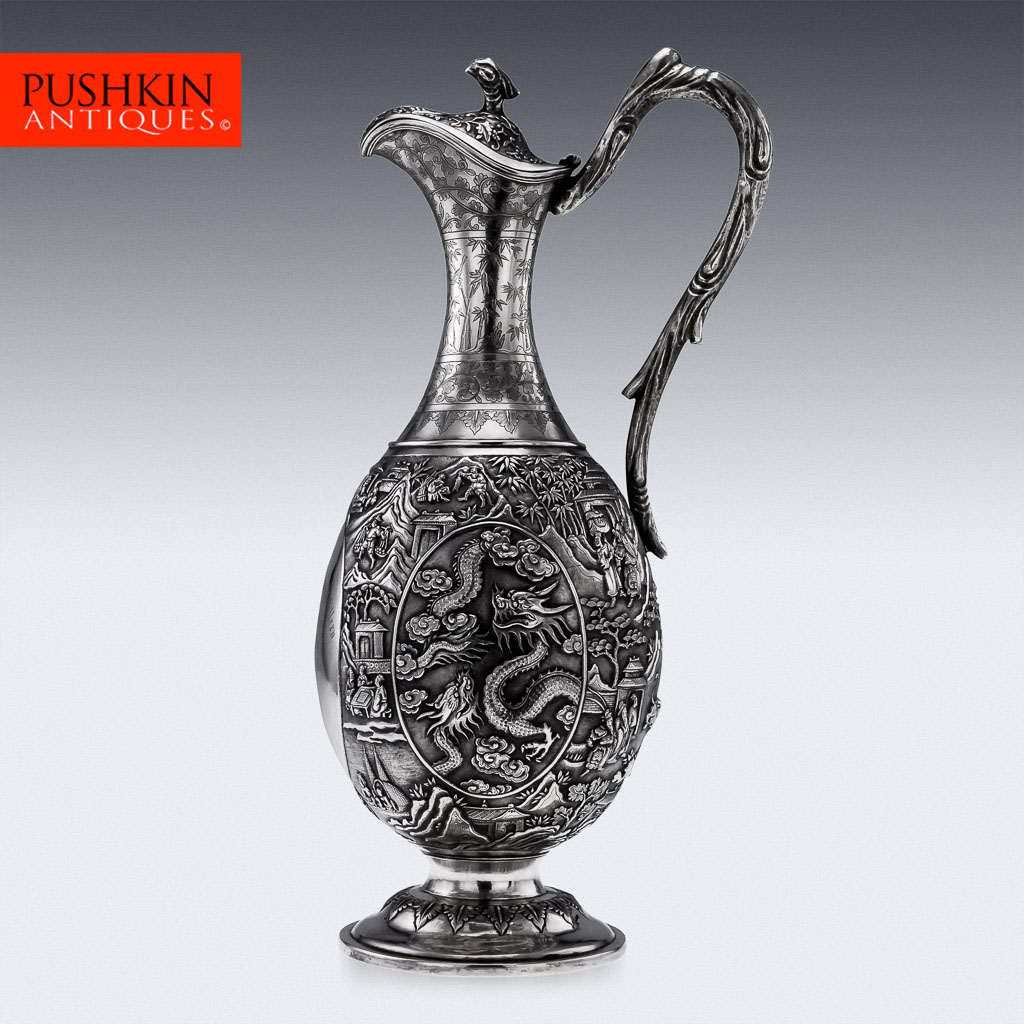
19th Century Chinese Export Silver trophy ewer, impressive and exceptionally fine, baluster form, the body showing a compendium of the finest techniques and styles used in Chinese Export Silver: the domed circular base chased with stylized leaves, the round body featuring an oval medallion on each side depicting flying dragons in relief amongst clouds, surrounded by a densely populated landscape with mountains, buildings and trees, depicting a great number of figures and animals, the neck engraved with decorative stylized naturalistic patterns, in a style that had strong influence on the Victorian decorative art with the so-called "aesthetic movement", the handle naturalistcally modelled imitating a branch, chased hinged cover surmounted by a similarly shaped finial.
The decoration is extremely crisp and detailed, the ewer shows almost all the patterns and decorative techniques used in Chinese Export Silver, like engraved stylized scrolling foliage, bamboo leaves, dragons in relief, the naturalistic branch-like handle, the most popular and sought after village scenes. Hallmarked Chinese silver (90 for 900 standard), Maker's mark "WH90" for Wang Hing.
Reference Number: A3263

19th Century Chinese Export Silver large biscuit box, of typical cylindrical form, decorated in repousse' relief with dragons chasing the flaming pearl on a matted ground, the hinged cover chased with a dragon, sermounted with a protruding head as a finial. Hallmarked Chinese Export silver (900+ standard), Mark CW for Cumwo of Hong Kong.
Reference Number: A3535
Some of the most common decorative elements to be found on Chinese silver of this period are bamboo leaves, chrysanthemums, orchids, plums, cranes, dragons and crowded figural scenes representing Immortals, gods and battles. To Western eyes, these are simply decorative; to Chinese eyes, every motif or combination of motifs convey a meaning.
The countless variations and imaginative use of the “dragon”, considered symbol of power and reference to the Emperor, became the most recognisable element distinguishing the late 19th century and early 20th century Chinese export silver. It became the signature of prolific silversmiths and retailers such as Wang Hing, Tuck Chang, Luen Wo, Leeching, Kwong Man Shing, Da Xing, Cumwo with Tu Mao Xing, a manufacturer and retailer, now considered the “king of dragon makers”. The silver marks commonly used on silver produced during this period have Chinese chop marks often combined with Latin alphabet initials. China has never had an assay system, so the information conveyed in the silver marks are minimal at best.

19th Century pair of Chinese Export Silver Goblets, of typical bell form, large size, each body is profusely and beautifully decorated with different scenes, one with a dragon moving in and out of the surface, the other with shaped panels depicting bamboo, a dragon, flowers and figures, both resting on a circular base chased with flowers and knopped stem. Hallmarked Chinese Export silver (900+ silver standard), Mark "WH" for Wang Hing.
Reference Number: A3446

19th Century Chinese Export Silver seven piece tea and coffee service on a tray, comprising of coffee pot, teapot, sugar bowl, milk jug, slop bowl, tea caddy and tea strainer, all on the original twin-handled tray, each spherical body is beautifully chased with bamboo leaves on a matted surface, each piece rests on a decorative skirted foot and is applied with an intricately modeled bamboo handle, outstanding quality. Hallmarked Chinese Export silver (900 standard), only the strainer bearing the mark "MT", all the other pieces (including the tray) bearing the Maker's mark in Chinese for Tu Mao Xing.
Reference Number: A3356

19th Century Extremely Rare Chinese Export Wang Hing Silver & Enamel bowl, the sides are applied with shaded enamel, depicting blooming chrysanthemums & cherry blossom. The bowl is of good traditional size and features stunning workmanship. Hallmarked Chinese silver (90 for 900+ standard), Mark "WH" for Wang Hing.

20th Century Chinese silver gilt filigree cup & cover, the cup is richly gilded and applies with jade and amethyst gem stones. The cup stands proudly on a sexafoil base, with a floral spread upon which three roosters lift the cup with there plumage. The cup body and the lid panels applied with floral shaded enamels. Hallmarked Chinese Export Silver (900 silver standard), year 1950's.
REFERENCE NUMBER: A4287
The post-China trade and Republic periods are characterised by the introduction of Western-style department in major cities, Hong Kong and Shanghai in particular. The rise of a Chinese middle class and an explosion of ex-pat residents in treaty ports and Hong Kong created the need for more commercial, but still high quality silver items.
During the Cultural Revolution and after, silver started to be produced by state-owned workshops and was simply stamped “MADE IN CHINA” and “SILVER”.
Often wrongly associated with Chinese export silver is Straits Chinese silver (circa 1835-1935), technically a silver category in its own right. It refers to the silverware produced by local and mainland Chinese workshops for Peranakan communities (descendants of Chinese immigrants) living in the Malay Archipelago, including Malaysia, Indonesia, Vietnam and Singapore. This type of silver is less influenced by Western styles, often incorporates Islamic-inspired or Buddhist motifs and generally carries Chinese chop marks.



Antique early 20th Century Chinese export solid silver tea and coffee service, comprising a coffee pot, teapot, milk jug, twin handled sugar bowl, sugar tongs and an oval serving tray. This service is decorated throughout with intricate repoussé and chased designs depicting dense bamboo foliage, birds and naturalistic motifs, showcasing the remarkable craftsmanship and attention to detail associated with Chinese export silver of the period.
The coffee pot and teapot feature striking faceted bodies, each adorned with vertical panels of finely worked botanical decoration, complemented by bamboo form handles and spouts. The hinged covers are surmounted by sculptural bamboo finials. The matching milk jug and twin handled sugar bowl also feature the elaborate decoration of the principal pieces, creating a beautifully unified ensemble. The service is completed by a pair of decorative silver sugar tongs. The substantial oval serving tray is particularly impressive, featuring an extensively decorated surface with intricate bamboo foliage and birds amongst vegetation. This visually striking service would make an outstanding addition to any important collection of antique silver or a magnificent tea service for formal entertaining. Each piece hallmarked Chinese solid silver mark "90" (900 standard), Makers chop mark (Ineligible), Retailer mark "WH" (Wang Hing & Co).
Reference Number: A00235